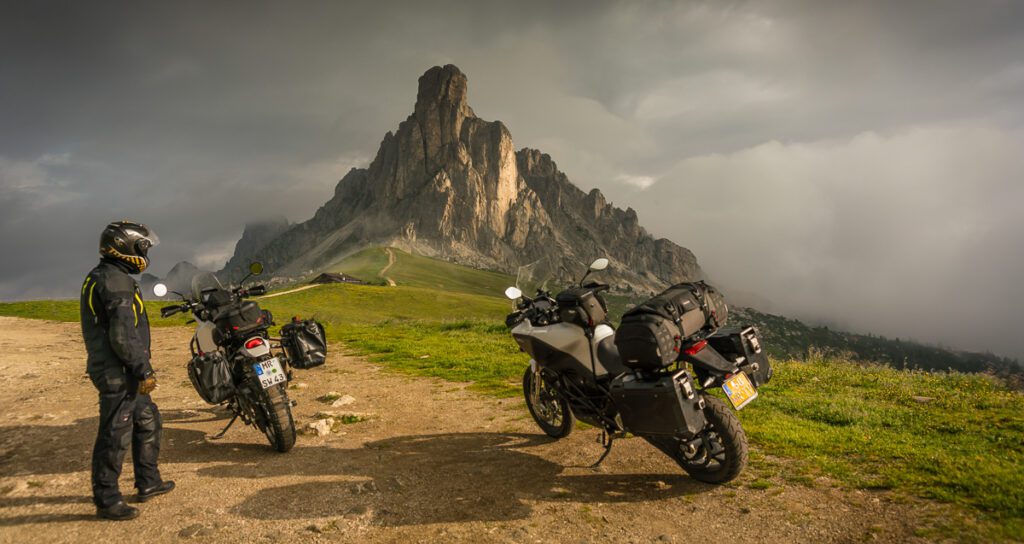
I did not ride the Passo di Giau until the summer of 2023. Of course I had heard of it, as many of my friends ride it regularly. But I wouldn’t have found it on the map without help. Uli from moppetfoto.de finally drove ahead and we spent three days on this dream road.

This story about the Passo di Giau appeared in the “Passportrait” series in MOTORRAD, Europe’s largest motorcycle magazine, issue 19.2023 (September). The Passportrait is a collaboration between Uli from www.moppetfoto.de and myself.
Before you read, please note: this post was translated with the help of Deepl.
If you find any errors – please have fun first and then give me a hint.
We are in the Ampezzo Dolomites, in the northern Italian province of Belluno. Here, the Passo di Giau runs in a NE-SW direction and connects the famous Olympic and winter sports resort of Cortina d’Ampezzo with the small, lesser-known municipality of Selva di Cadore in the Buchenstein Valley.
The pass lies in the middle of a vast Alpine pasture landscape, framed by striking and mysterious mountains. These grazing grounds were disputed for centuries – the Habsburgs and Venetians claimed them for themselves in equal measure. The remains of the Muraglia di Giau, a dry stone wall once two kilometres long, which finally divided the usable land into two halves for the sake of peace, can still be seen by attentive eyes.
At Pocol, a few kilometres from Cortina d’Ampezzo, the SP638 leading over the pass turns off to the left from the Great Dolomites Road and the eastern ramp of the Falzarego Pass. It starts off relatively flat, even descending for a short stretch, before climbing through dense forest after crossing the Falzarego stream.
The route, which until then had felt unanimous, quickly changes into a winding back and forth. The tarmac is in good condition, has good grip and is easy to drive on, and the carriageway is mostly wide and clear. There are only a few bumps, ruts and cracks to challenge the chassis. Road markings are literally only found at the edges, slippery bitumen snakes are rare.
In recent years, many sports car drivers have also discovered this entertaining area for themselves; it is no coincidence that sections of the road are now limited to 60 km/h and less. As on so many other Dolomite passes, it’s not the worst idea to ride cautiously and carefully.
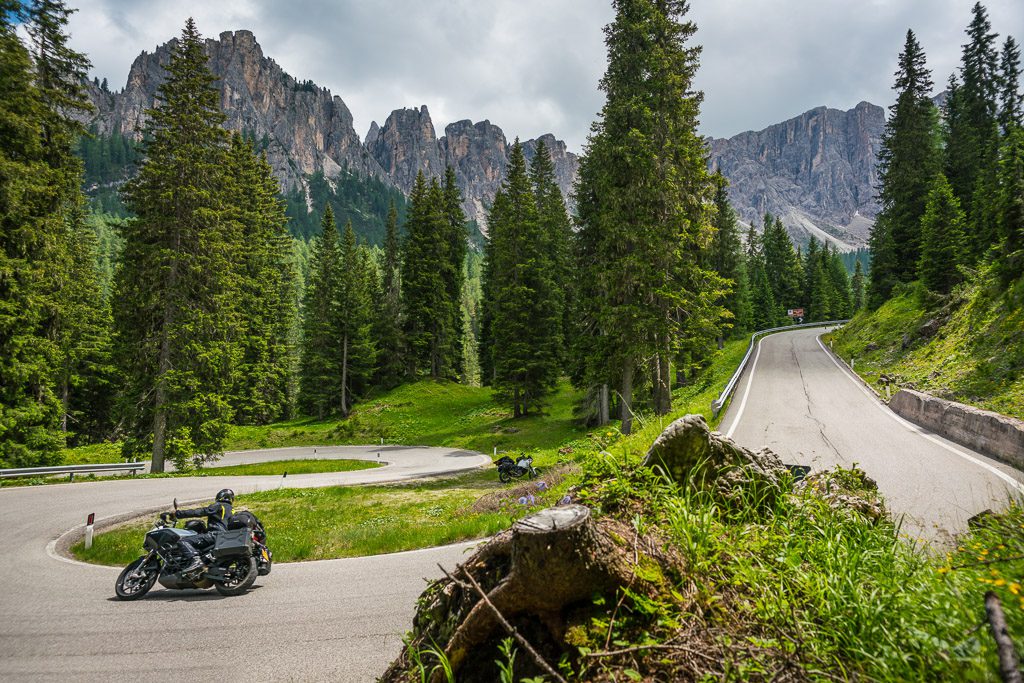
Despite all the scenery, the driving fun is not neglected
But it’s not just the grip and the winding road that are appealing. Hiking trails lead from numerous car parks deep into the woods and finally up to the pale, all-dominating mountains. The enchanting landscape around the Giau Pass and the top of the pass in particular are very popular, especially at summer weekends.
If you can take your eyes off the tarmac winding in front of your front wheel as you search for the most beautiful line through the many hairpin bends, 55 in total on the two pass ramps, you can already see the stone structures of the imposing Dolomite towers peeking out between the tree trunks.
About nine kilometres after the start at Pocol, the forest boundary is crossed. Large boulders lie in the lush meadows, around which the road winds for the sake of simplicity. On the left, rocky spires rise sharply and pointedly into the sky, accompanied by flat and smoothly weathered stone plateaus. Below the impressive Lastoni di Formin mountain range, grey-white scree slopes spread out, reaching down to the valley floor and into the forest there.
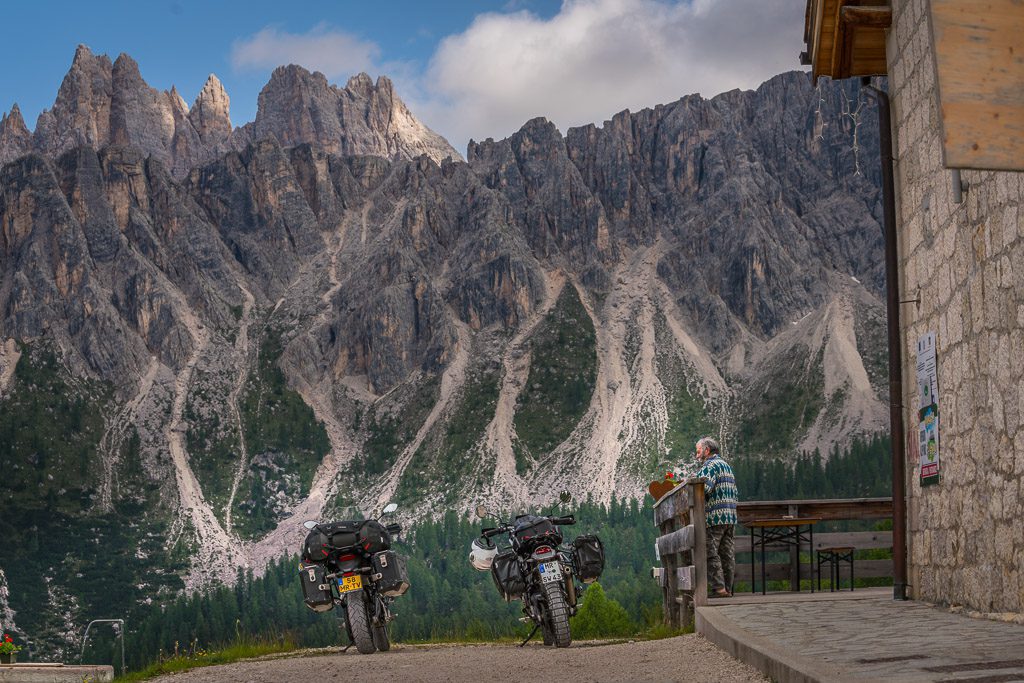
Impressive mountain world vis’a’vis the Rifugio Malga di Giau
The sight of these pale mountain giants is an unforgettable experience, especially in the morning or evening hours in the warm sunlight.
The eternal work of erosion is more than strikingly recognisable on these never-ending mountain ranges – blocks the size of houses hang on steep gravel slopes and seem to want to slide down further at any time. This gives the impression of complete devastation, and yet even on the highest stone needles there are individual trees defying the aggressive weather. The route of the original road leading up to the Giau Pass, on the other hand, struggles against the gradually overgrowing force of nature: only pale boundary stones protrude from the green grass and the bright red of the alpine roses.
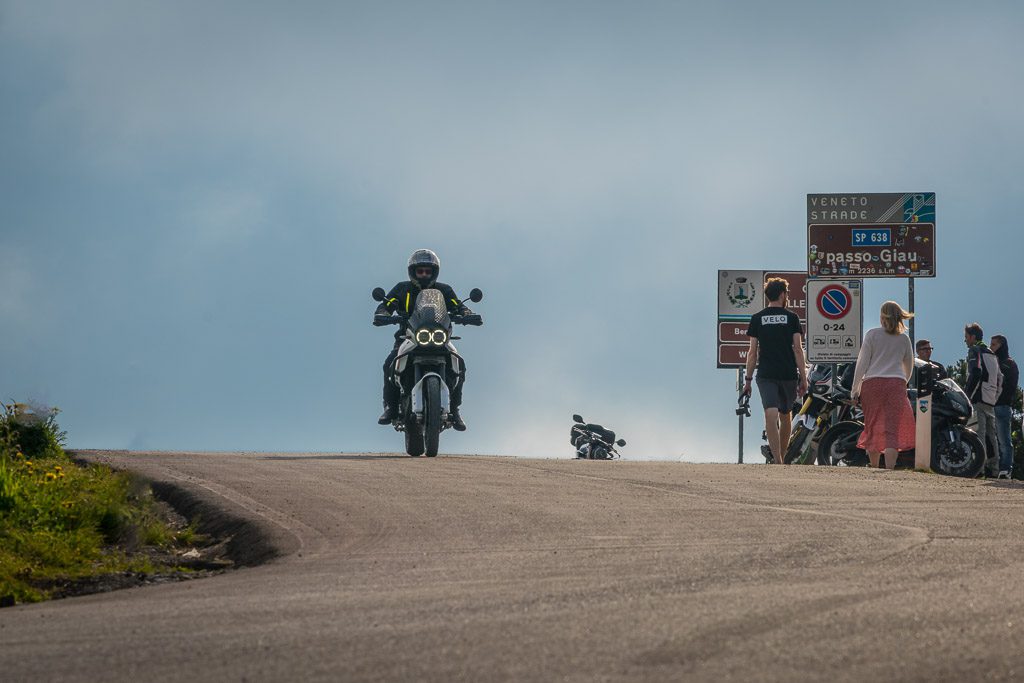
At lunchtime, the beautiful Passo di Giau is very busy
The top of the pass is reached as you pass the 31st hairpin bend. In the shadow of the striking Ra Gusela, which towers mightily behind the summit, a magical panorama of the surrounding mountains opens up: you should definitely take the time to let your gaze glide over the glaciated Marmolada, the highest mountain in the Dolomites, the Sella Group or the Monte Cristallo massif not far from Cortina d’Ampezzo. A large car park and the mountain hotel as well as a slightly ascending hiking trail in the direction of Ra Gusela offer the opportunity to do so.
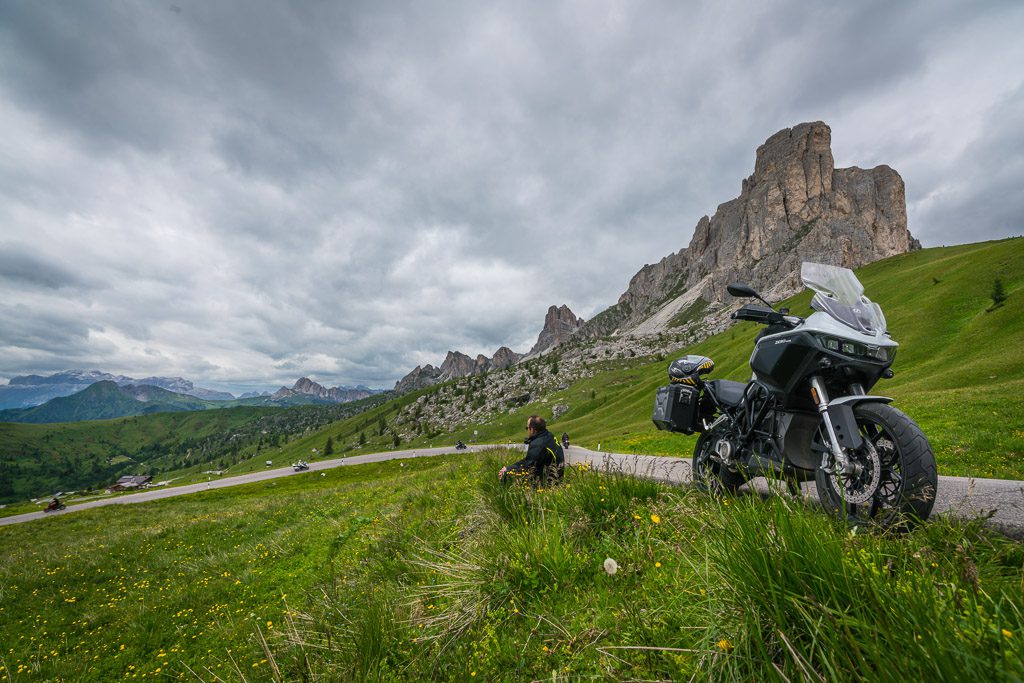
In the shadow of the Cinque Torri at the Passo di Giau
Unsurprisingly, the area around the Giau Pass was also bitterly fought over during the First World War. “La Grande Guerra” – the Great War – is thematised and reappraised in many places in display boards and restored positions. In Pocol, a military cemetery dating back to 1935 tells of these horrors: Almost 10,000 soldiers, most of them unnamed, are buried there.
After crossing the top of the pass, on the ride down to Selva di Cadore, an undulating sea of meadows dotted with red alpine roses spreads out. Neither crash barriers nor other protective structures stand in the way of the view of the gentle Alpine pastures or the mountain ranges rising out of the haze in the distance. On the right, an imposing sea of rocks passes by at the foot of the “Cinque Torri” – Italian for “Five Towers” – one of the most famous climbing areas in the Alps.
On reaching the Rifugio Fedare at 2000 m above sea level, you are left with an ancient cultural landscape characterised by weathered, blackened wooden huts, but also by not-so-modern lifts and somewhat dilapidated hotel buildings.
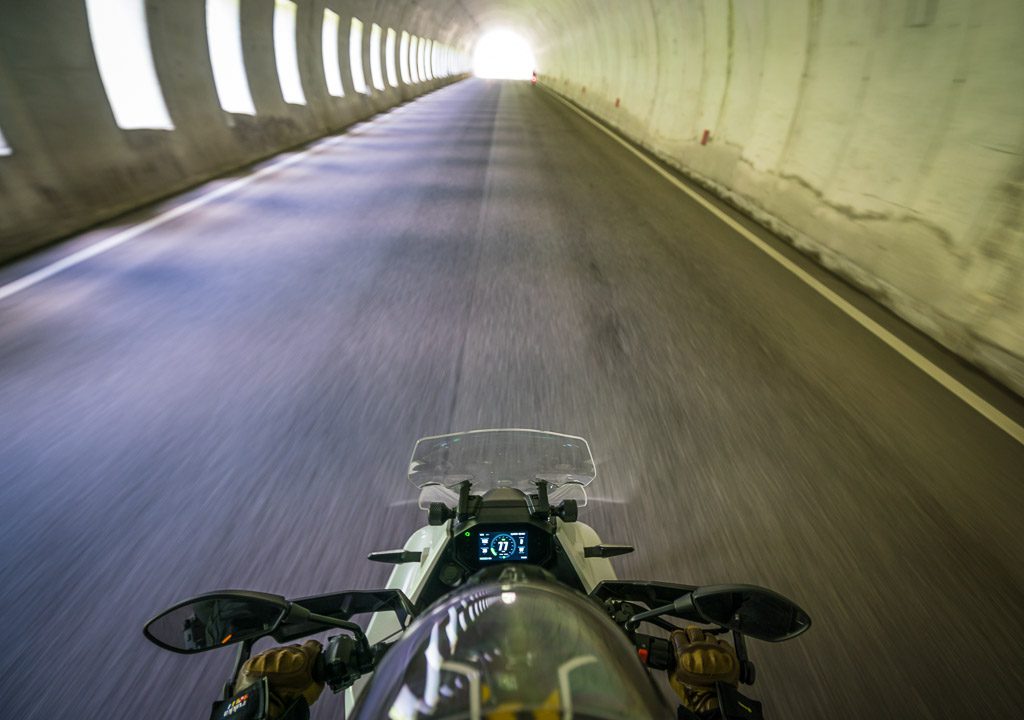
Tunnel view at the Passo di Giau
Giro d’Italia fans have turned the SP638 into a book with slogans, cheers and star names. From here, it winds its way back through increasingly dense forest, dropping into the depths with impressive gradients in sections and passing massive avalanche protection galleries. The storm Vaia, which hit the Dolomite forests with furious force at the end of 2018, fortunately spared this valley in large parts; the destructive bark beetle has also kept a conspicuously low profile and the conifers are healthy on the slopes. In view of the humiliating state of some of the surrounding forests, this is a conciliatory sight.
The road changes sides of the valley several times as it continues. On the 10-kilometre-long south-west ramp, there are 29 hairpin bends, some of which feel like they are on top of each other and, in the lower section, merge into each other in quick succession.
The force of the plunging Costalunga stream is slowed down by several stone steps, but there are still huge boulders in its bed. Is it safe to ride over the bridges here during a heavy summer thunderstorm with expected white water?
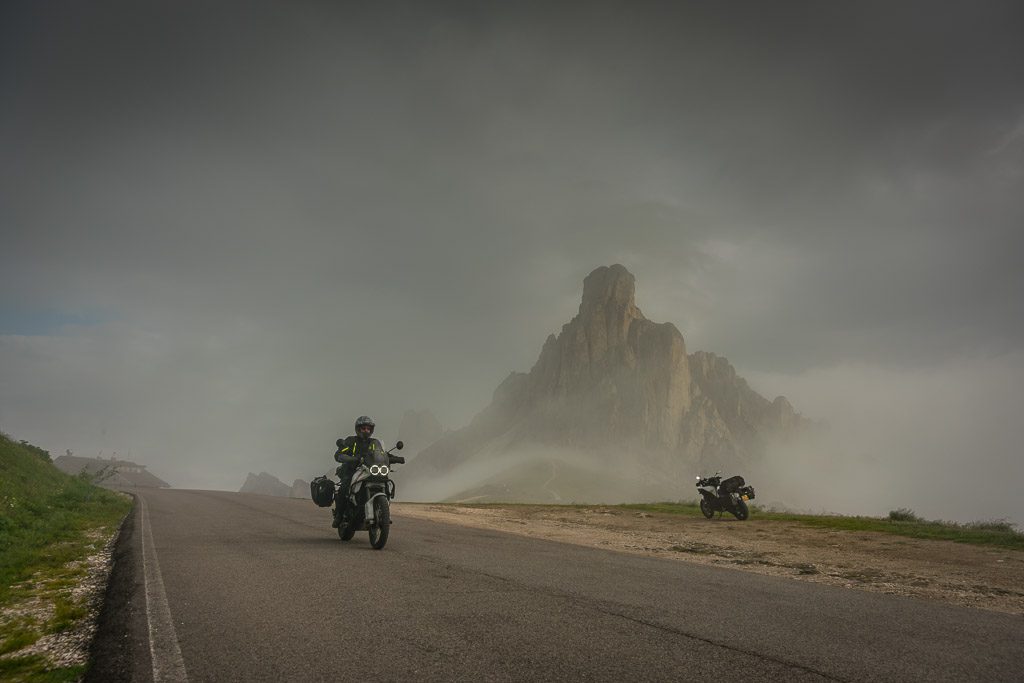
At 6.00 a.m. over the deserted Passo di Giau
After crossing a bridge for the last time, the road ends at the junction with the SP251, within sight of Selva di Cadore. There are numerous other Dolomite classics in the immediate vicinity, such as the Falzarago Pass, the Passo Staulanza or the Fedaia Pass at the foot of the gigantic Marmolada. But probably the most impressive panoramic experience remains at the top, at the summit of the Passo Giau.
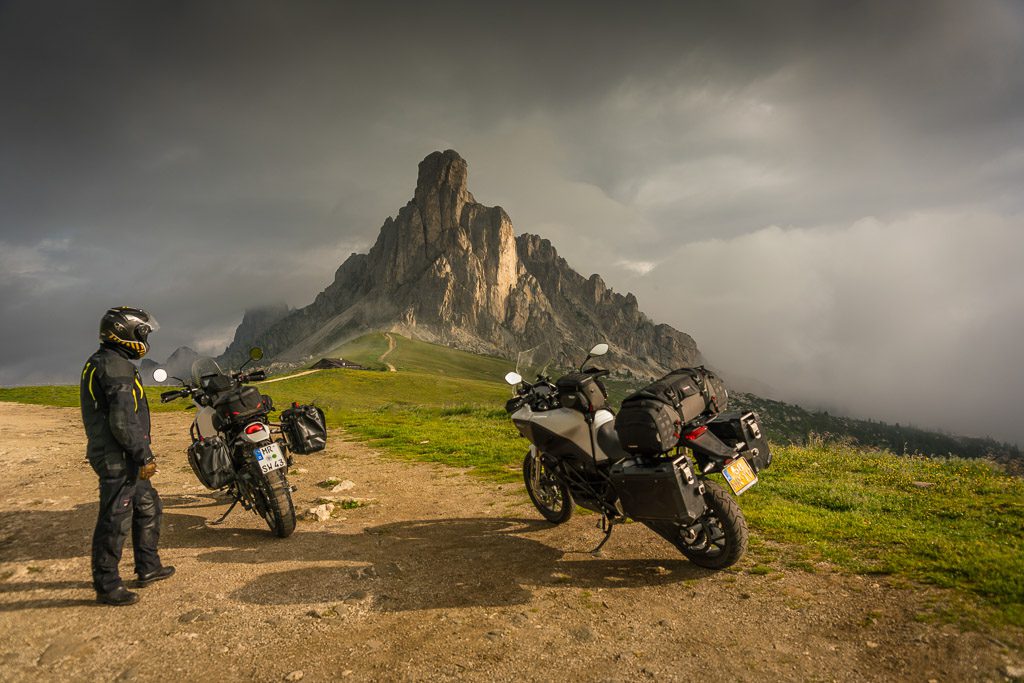
I couldn’t tear myself away from this sight
Passportrait Passo di Giau: Thank-yous, High-Fives & Links
- Rukka Motorsport
On the ride over the Passo di Giau, my Rukka textile suit and gloves once again served me well. Whether in the heat or in the icy morning showers. - SW-Motech
The spacious Pro Travelbag tail bag and the super-practical Pro Enduro tank bag from SW-Motech also accompanied me on this tour. In addition, we could ride the beautiful Ducati DesertX with lots of accessories from SW-Motech – thank you very much! - Nolangroup Deutschland
Once again, the X-lite X-1005 Ultra Carbon has proven its worth: It is a top helmet. Comfortable when riding, practical when taking photos. - Zero Motorcycles DACH
Many thanks for providing the brilliant DSR/X! The perfect motorcycle for the tour through the Dolomites World Heritage Site. Electrifying! - Rifugio Malga Giau
We enjoyed first-class cuisine and peaceful nights in the beautiful mountain hut at 2000 metres above sea level. Grazie Mille!
Perfectly matching

Let’s climb the Stelvio together!

Stelvio – Count from 1 to 10!
Have fun looking at them!

Magical Moments

Dream Roads: The Gavia Pass (2621 m)

Dream Roads: The Susten Pass (2224 m)
Unimaginable?