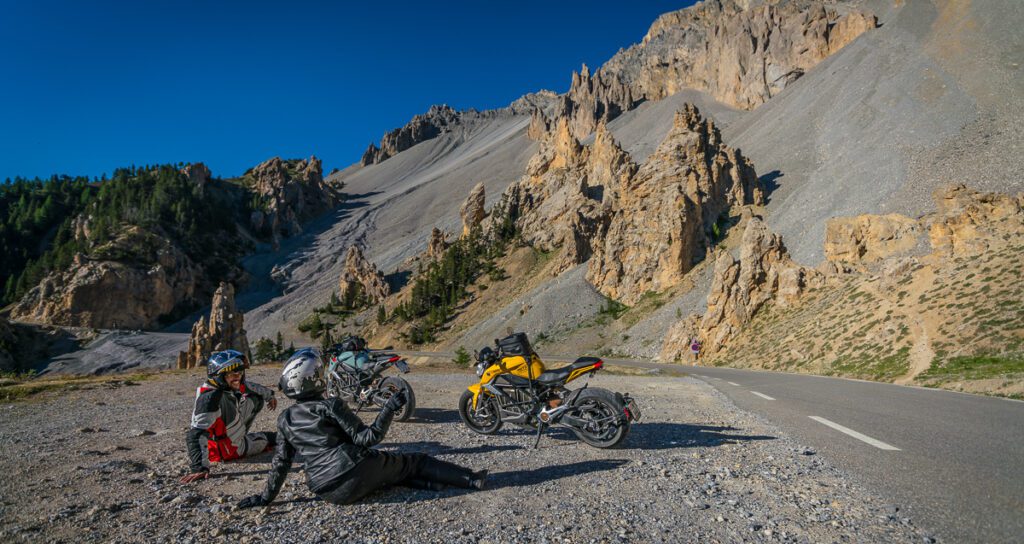
The Col d’Izoard: I rode it many years ago on a Harley-Davidson as part of an extremely speedy tour group, bringing back only a single photo – and no memories. That’s different now: In the summer of 2022, Uli from moppetfoto.de, Julia from maedchenmotorrad.de and I visited this classic of the Route des Grandes Alpes and took our time.

This story about the Col d’Izoard appeared in the “Passportrait” series in MOTORRAD, Europe’s largest motorbike magazine, issue 15.2023 (July). The Passportrait is a collaboration between Uli from www.moppetfoto.de and myself.
Before you read, please note: this post was translated with the help of Deepl.
If you find any errors – please have fun first and then give me a hint.
The Col d’Izoard is located in the French department of Hautes-Alpes and connects Briançon (1220 m) in the north-west with the Guil valley (1266 m) and the village of Guillestre (1000 m) in the south-east. It is the third highest pass on the Route des Grandes Alpes and overcomes a difference in altitude of 1141 m over a distance of approx. 35 kilometres.
Its valley villages can be reached more easily and quickly along the Durance – so the Col d’Izoard is basically of no importance for transport in the region. Instead, it fascinates with its marvellous course through dense forests and along deep gorges, and especially with its desert summit area.
At Briançon, the D902 initially winds its way through a residential neighbourhood and only slowly gains height. Undulating, bumpy and literally a wake-up call, it follows the Cerveyrette, which has carved a mighty gorge into the rock. Otherwise, the route does not demand much: the village of Cervieres is reached without any narrow sections or hairpin bends. Behind it, a grey mountain massif rises upwards, surrounded by mighty scree slopes.
Fittingly, the village consists of narrowly built stone houses and attracts attention as you drive past, despite the screaming winter sports adverts. The green spaces around the village are littered with piles of stones – making renovation easy.
Up to this point, the road was of neglected design, wedged between a pressing mountain and bent crash barriers, scarred by rockfalls and torn by destructive weather. From Le Laus, however, it becomes a marvellous playground for anything that rolls.
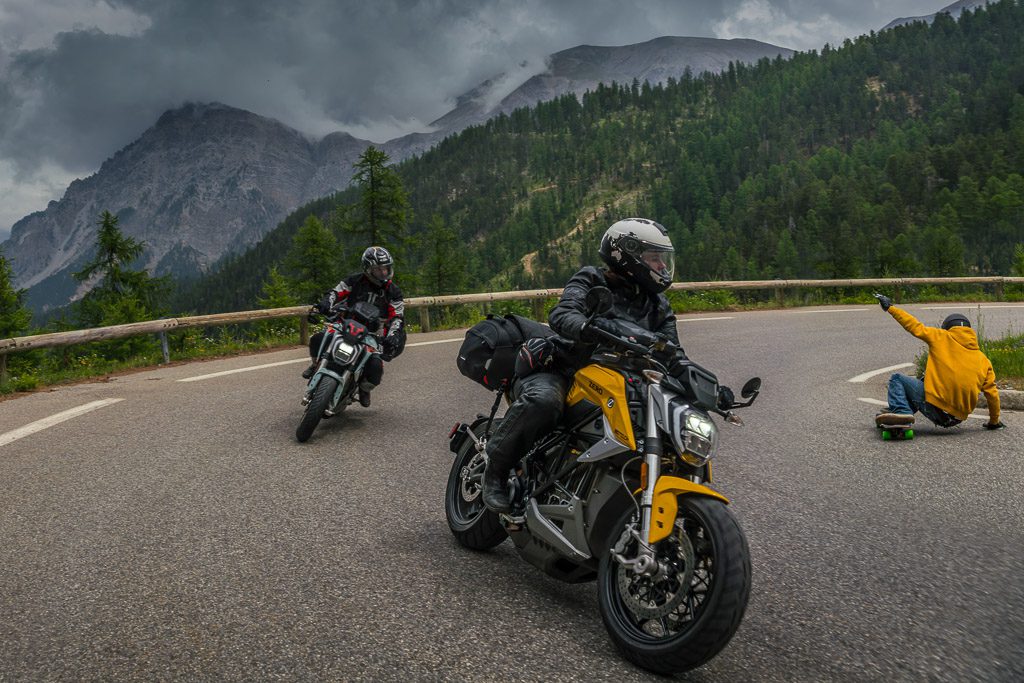
Encounters of a special kind: naturally on the Col d’Izoard
(Photo: www.moppetfoto.de)
A lane reserved for cyclists up to the top of the pass and steles with information on distance, altitude and the current gradient ensure shared enjoyment. The enviably beautiful tarmac is also celebrated by longboarders, some fully clad in leather, others with their hands clad only in motorbike knee sliders. Downhill, they perform crazy acrobatics and uphill, ten of them crammed into a single car, they demonstrate the laid-back French way of life.
The finest hairpin bends, flowing and, if desired, quickly drivable, allow for a marvellous motorbike dance. Nature outdoes itself between the serpentines, which follow each other in quick succession, sometimes drifting steeply upwards and – naturally – supported by stone walls. The forest floor is covered in a rarely seen abundance of plants and the air is so densely populated with insects that it is highly recommended that you ride with your visor closed.
This vegetation sensation extends to just below the pass, the tree line is in the immediate vicinity of the Refuge Napoleon at 2108 metres above sea level. There, from the best possible vantage point, you get your first glimpse of the characteristic Izoard summit region.
In the middle of an arena of yellow-white stone, framed by the scars of torrents falling into the valley and crowned by dissolving limestone, which from a distance resembles the crests of waves, the last five hairpin bends wind their way up to the pass. At their apexes, photographers hunt for the perfect angled photo, numerous cairns greet you in the sparsely growing grass.
In dark gravel fields, yellow-grey rock figures cast long shadows over the scree. Individual trees defy the rough, high alpine weather, standing proudly in the middle of the rock.
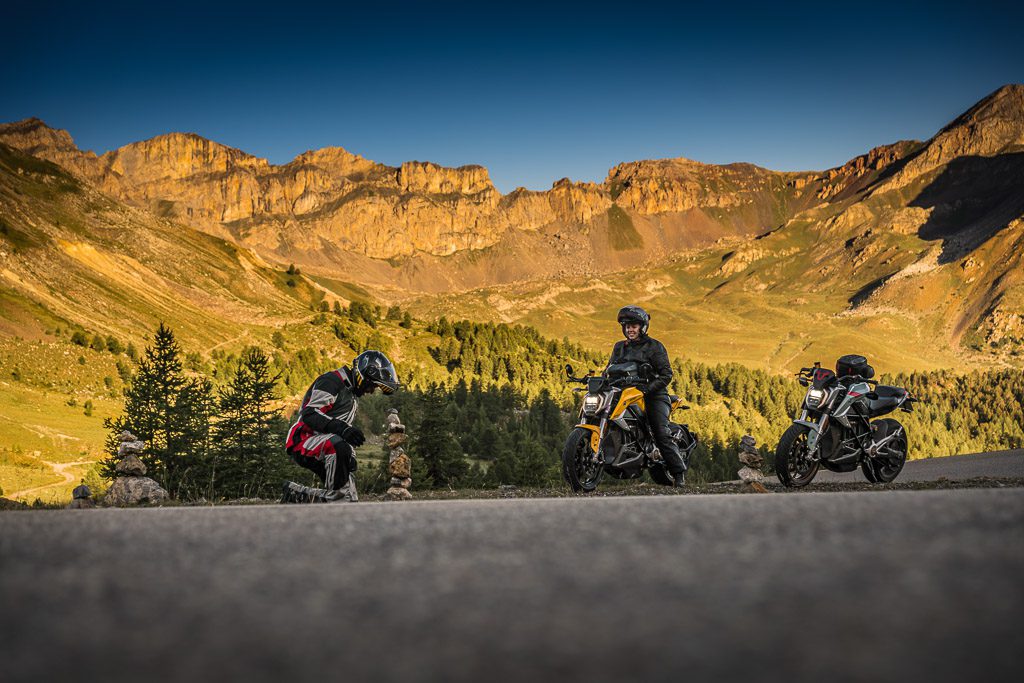
Rich in stones: fun on the Col d’Izoard
(Photo: www.moppetfoto.de)
The Col d’Izoard pass will still be disarmingly simple in the summer of 2022, but extensive construction work will change this. An obelisk erected on the plateau in 1934 tells the story of this crossing and honours the builder General Baron Berge, who with his troops carried out the design and construction of the “Route des Alpes”. To the right is a museum with information on the history of cycling, and a paved car park will be added in place of the open area left to itself.
The route over the plateau is short, and the road immediately descends towards Queyras. On the mountainside opposite, huge flocks of sheep provide an animalistic soundscape that easily drowns out the Torrent de l’Izoard, which has its source here.
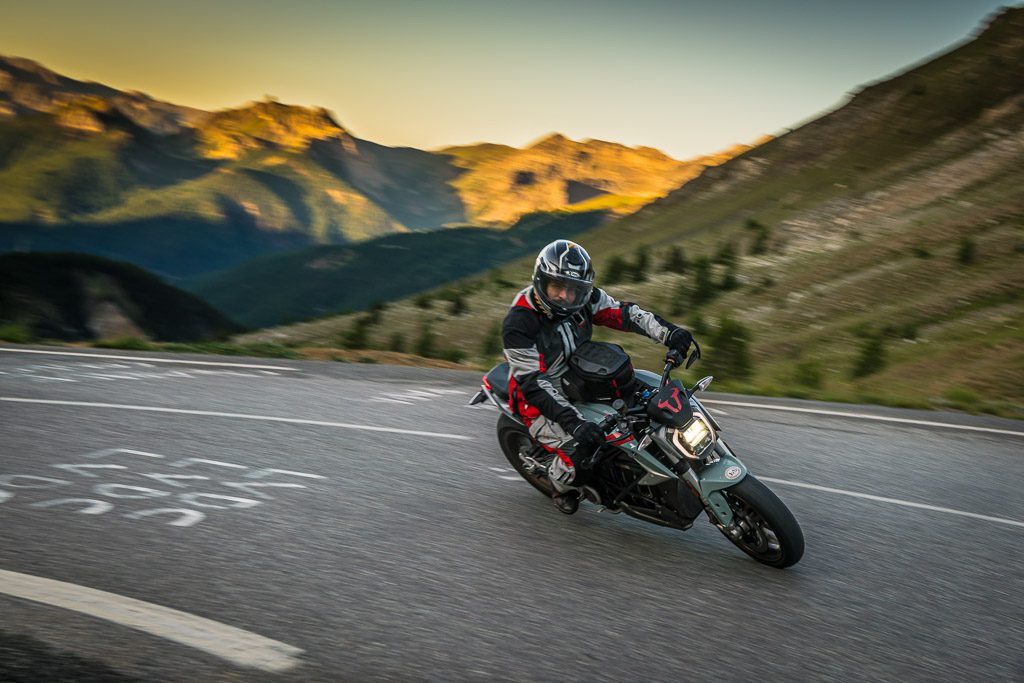
Unusual at this altitude: first-class road surface
(Photo: www.moppetfoto.de)
Three sweeping hairpin bends, garnished – no, littered – with Tour de France graffiti, lead down into the valley and merge into a narrowing carriageway. As is typical in France, this road runs unsecured along the edge of the precipice and actually demands all attention. But in the corner of your eye, a captivating landscape emerges, which you would rather have located in a distant desert.
The Casse Déserte: Hundreds of metres wide piles of rubble tower down from the mountain ridges, probably even obstructing the road during heavy rainfall – traces of heavy construction machinery speak for themselves. Rugged, huge and wild rock formations protrude from the rubble, broken, torn, weathered, overgrown only by the toughest high mountain plants, changing colour depending on the position of the sun.
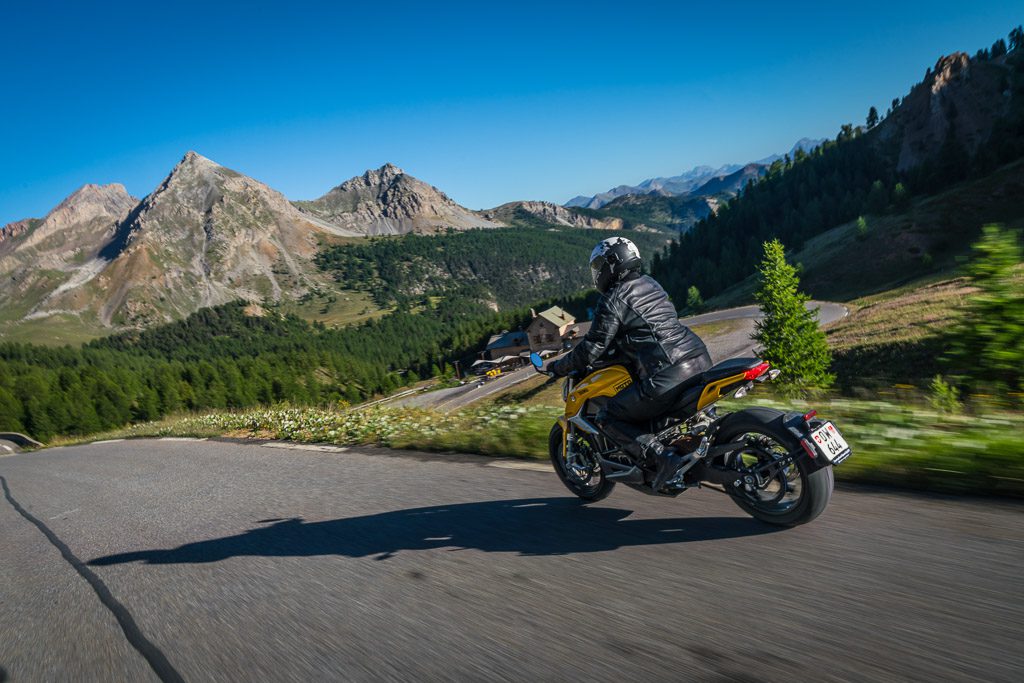
A very special accommodation: The Refuge Napoleon on the Col d’Izoard
(Photo: www.moppetfoto.de)
This spectacle lasts for half a kilometre – it is an overwhelming succession of impressions. Since time immemorial, once fused limestone and gypsum have been eroding here at different speeds, creating surreal effects.
Stopping directly in the Casse Déserte is not recommended, but neither is riding too fast. This is because nature doesn’t care about astonished people during its quarry activities, constantly throwing rubble. The car park at the nearby Col de la Plâtrière offers the opportunity to marvel at the whole thing in peace and safety. And from a distance, no-one would probably think of building a road through it – lucky for us, General Berge and his men did. The impressions of the Izoard summit landscape linger long after the journey continues.
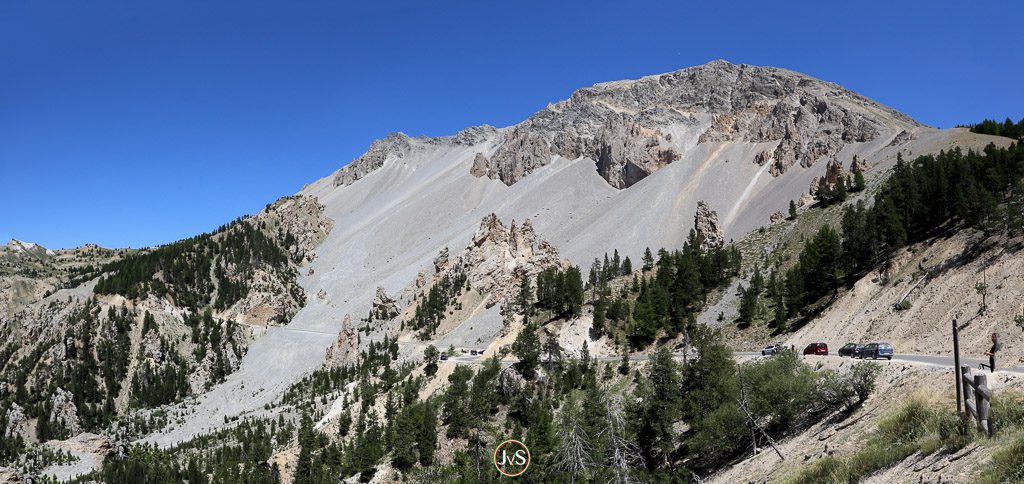
Casse Déserte
Eight partly elevated and first-class hairpin bends lie along the route to the south. A bitumen-free paradise of bends, actually ideal for getting back into the flow of bends after the captivating amazement of the summit region. However, the D902 only winds briefly through the dense forest before descending unspectacularly, evenly and without tight bends towards Arvieux.
A few kilometres later, at Château-Queyras, the road turns off into the Guil valley and follows the river, sometimes to the left, sometimes to the right, as far as Guillestre. The character is typically French: coarsely mixed asphalt that gnaws aggressively at the tyres, bordered on the uphill side by rough-hewn rock, on the downhill side a wall, at best only knee-high, protects against the uninhibited view into the stream bed.
Before the road winds its way high above the deeply incised, narrow Combe du Queyras through traffic-light-controlled, single-lane and unlit tunnels, the Guil greets you once again: dammed and with a penetrating green colour.
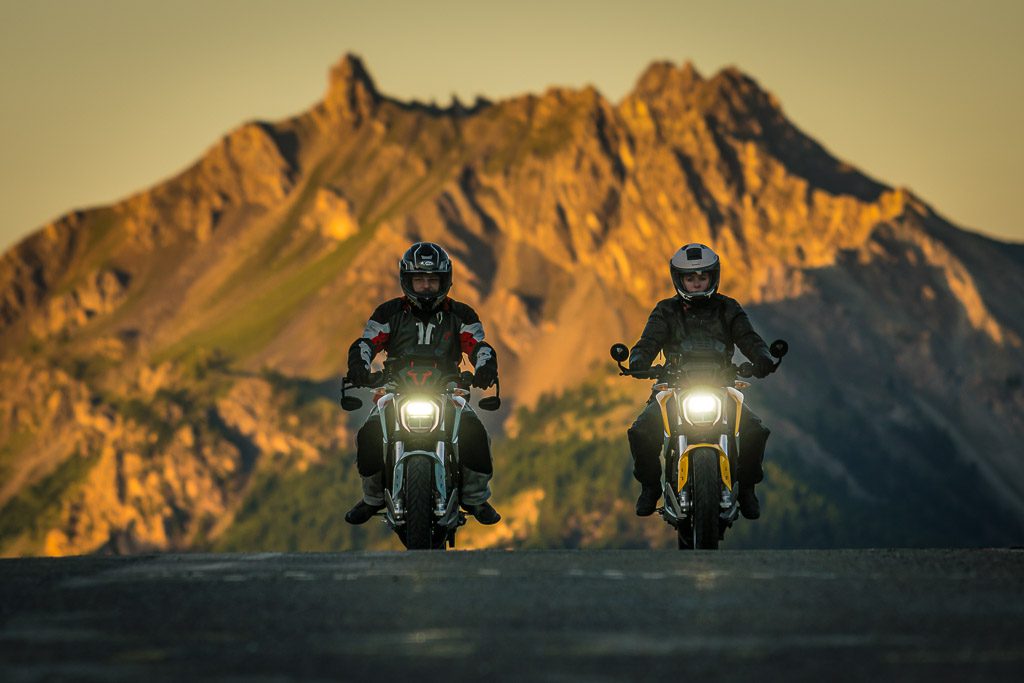
Fascinating play of colours in the early morning
(Photo: www.moppetfoto.de)
The ride over the Col d’Izoard is a must – a scenic and driving treat!
Passportrait Col d’Izoard: Thank-Yous, High-Fives & Links
- Rukka Motorsport
On the ride to and over the Col d’Izoard, my Rukka textile suit and gloves once again served me well - SW-Motech
All our motorbikes were travelling with the spacious Pro Travelbag rear bag and the super-practical Pro Enduro tank bags from SW-Motech - Nolangroup Deutschland
The ingenious X-lite X-1005 Ultra Carbon has proven itself once again: Top helmet, on the ride and for photography - Country Road Alpnach – Zero Zentralschweiz
Many thanks, Isa, for the technical support and for looking after the Zero SR and SR/F! - Comité Régional de Tourisme Provence-Alpes-Côte d’Azur
Un grand merci pour votre précieux soutien !
Perfectly matching:

Let’s climb the Stelvio together!

Stelvio – Count from 1 to 10!
Have fun looking at them!

Magical Moments

Dream Roads: The Gavia Pass (2621 m)

Dream Roads: The Susten Pass (2224 m)
Unimaginable?