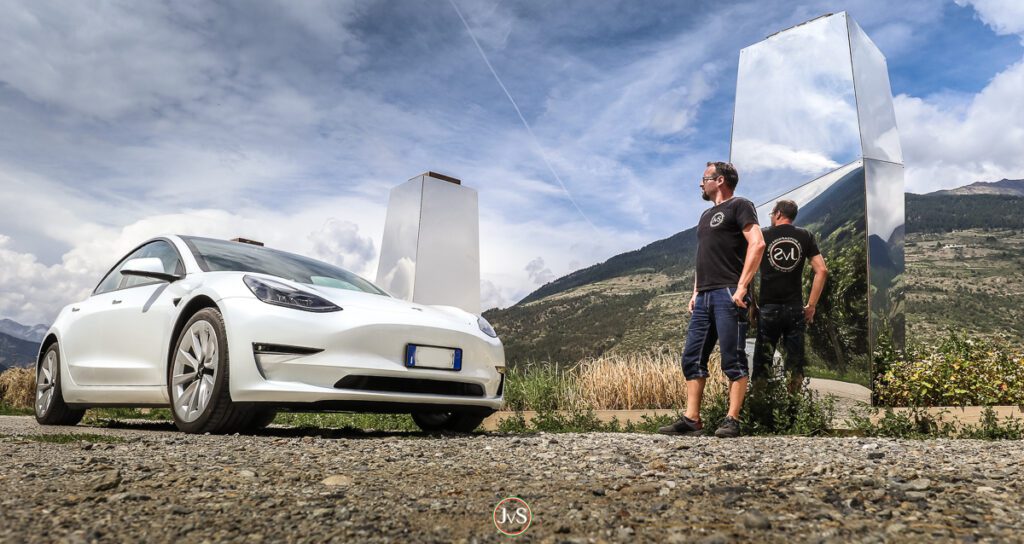
After more than two years on various electric motorbikes, I expanded the topic of electric mobility to four wheels in the summer of 2022: The faithful Opel Insignia was replaced by a Tesla Model 3 Long Range at the end of its warranty period. My conclusion after just under 30,000 kilometres.

Before you read, please note: this post was translated with the help of Deepl.
If you find any errors – please have fun first and then give me a hint.
I had the idea of commuting to work with an electric car for many years. The beautifully designed Opel Ampera with range extender would have been just my thing, but I couldn’t find a suitable offer. In the end, I dropped the idea, partly because of its poor winter suitability (no all-wheel drive, snow chains difficult to fit, low front). The choice fell on an all-wheel drive Opel Insignia sedan with Euro 6 diesel.
At the end of 2021, I spontaneously booked a test drive on the Tesla website. It was too tempting: after entering the desired model and date, the confirmation came within minutes.
On New Year’s Eve 2021, I drove a Model 3 through Bolzano – „thanks“ to Corona without a chaperone – along a short stretch of motorway, then along a narrow country lane, and somehow managed to get to grips with the virtually non-existent cockpit, the controls reduced to a minimum and, above all, the One-Pedal Driving. Automatisms learned over decades just don’t deactivate in half an hour.
Tesla Model 3 –
let’s go
Nevertheless, I ordered the same day, again without visiting a dealer and poring over brochures. After five minutes, the car was configured and paid for. Delivery date: May 2022. Perfect!
The app then provided regular updates on production, how-to videos, finally the registration papers and then – the delivery date. Rarely has a car purchase been so easy for me. The only thing I had to do was pick up the car myself: in Padova. A great opportunity for a city trip.
The drive from the Tesla Store to the city was exciting. Until then, I had never experienced city traffic of the quality found in Padova. Still overwhelmed by One Pedal Driving, I limped from traffic light to traffic light like a novice driver. It was only on the motorway that I finally got used to it.
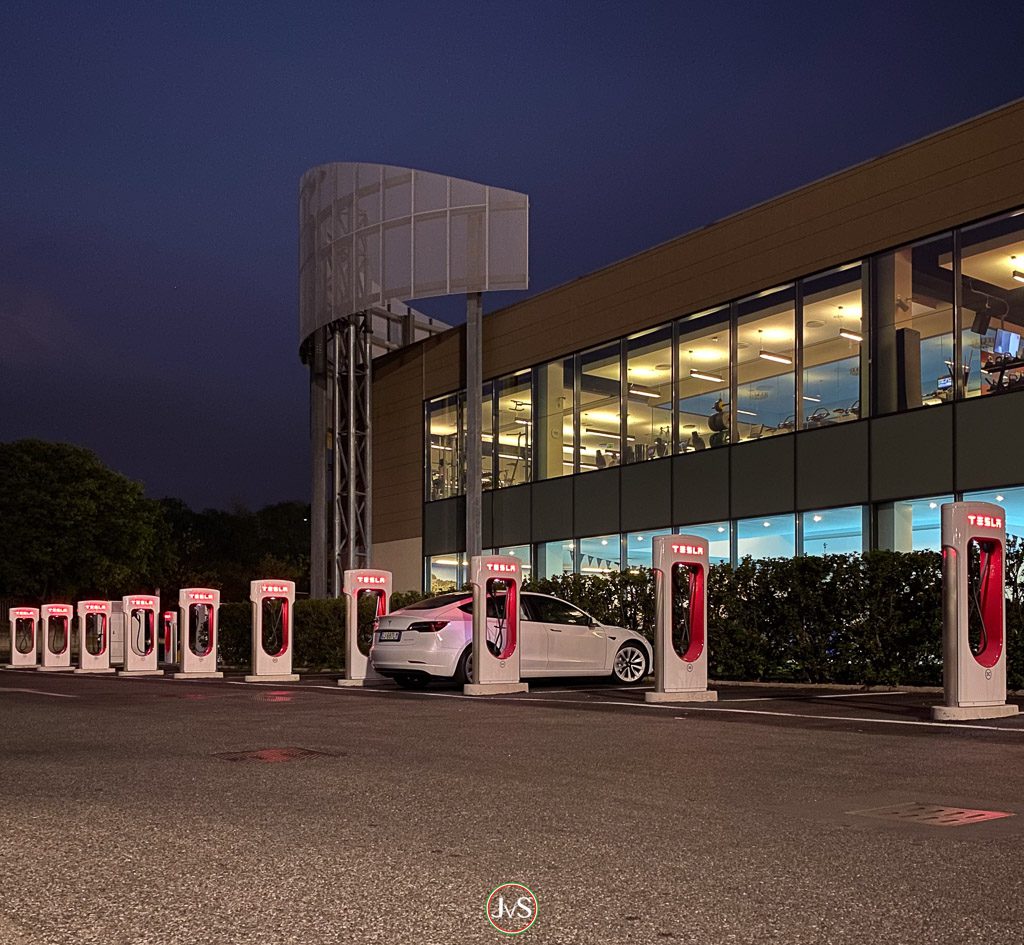
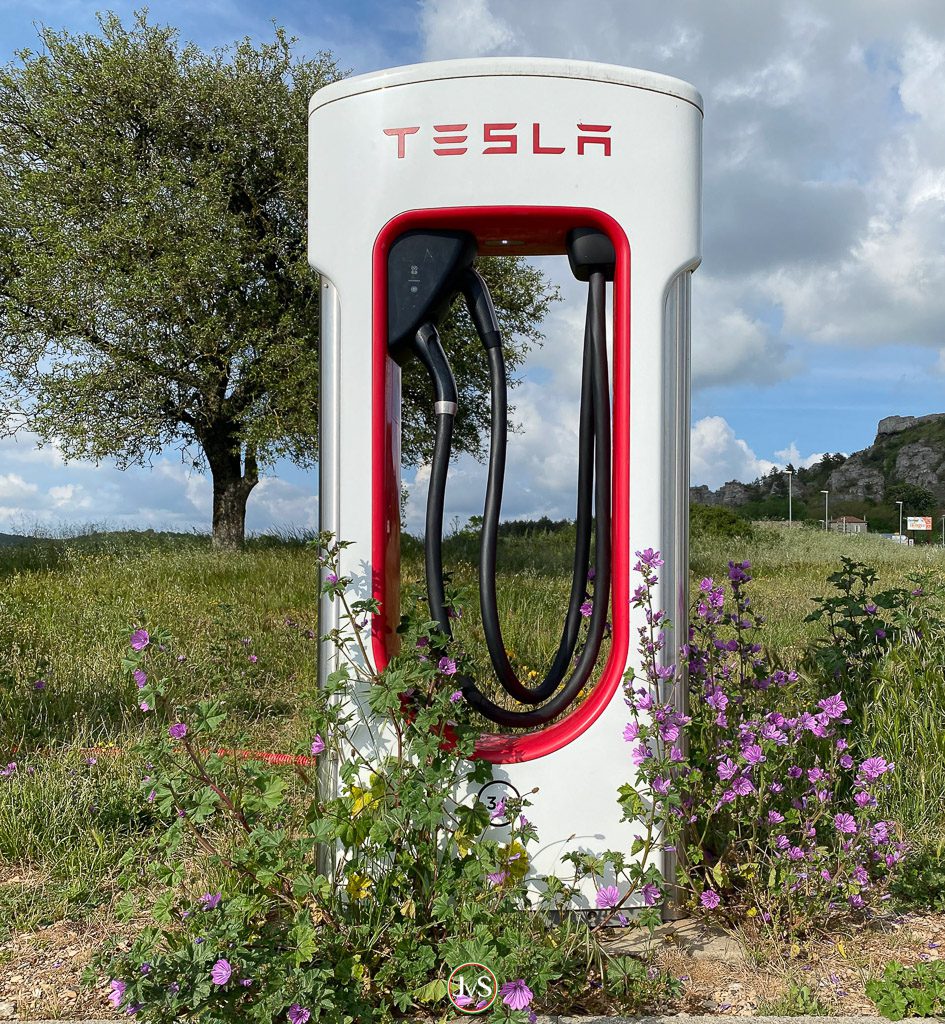
In Affi, I drove to a SuperCharger for the first time – plug in, done! No charging card, QR code scans or calls to a hotline – it was all automatic. I was able to follow the charging process in the app and shortly before reaching the selected SoC, I received a message to make my way to the car soon. Everything has been thought of.
The driving experience
in the Tesla Model 3
The first few metres were strange: The noise when starting up, engine vibrations – all missing. Silence inside, while the outside passed by with vehemence. A literally flying carpet – the modern diesel engine in the predecessor felt like an antiquated tractor engine in comparison: Pre-glowing when cold, nagging when warming up, powerless at low revs and without emphasis at high revs. Good old days …
The car pushes insanely forward: this is not acceleration, this is brutal kicking in the back without the slightest interruption in traction. Irresistible, as if pulled by a rubber band. Overtaking feels faster than on a motorbike. And I’m not thinking of my Harley, but of a beastly naked bike from Austria. Driving the perversely powerful Model 3 is childish fun.
So: off
to the holidays
Thanks to the Zero SR/F, I have become painless in terms of range anxiety and charging boredom – for the 2022 Provence holiday, I chose the electrician accordingly. First advantage even before the start: Luggage Tetris was not necessary, because the Tesla swallowed huge amounts of luggage. Second advantage: The price for the EnelX monthly subscription with 320 kWh was cheaper than a single (!) tank filling of the previous travel car, the Opel Cascada.
As in previous years, the journey was divided into two stages: 400 kilometres via Sankt Moritz and Lake Como to Turin, followed the next day by another 350 kilometres via Briançon and Digne-les-Bains to Draguignan. Charging stops on the way were not necessary, the destinations were each reached with around 30% remaining capacity and then recharged somewhere there. The Tesla navigation system found enough power sources within a useful distance of the accommodation.
Two weeks of driving through Provence: The low consumption as well as the possible ranges through leisurely driving and recuperation when going downhill were fascinating – the used kWh were recharged at (free) charging points in an underground car park in Draguignan or directly at the accommodation.
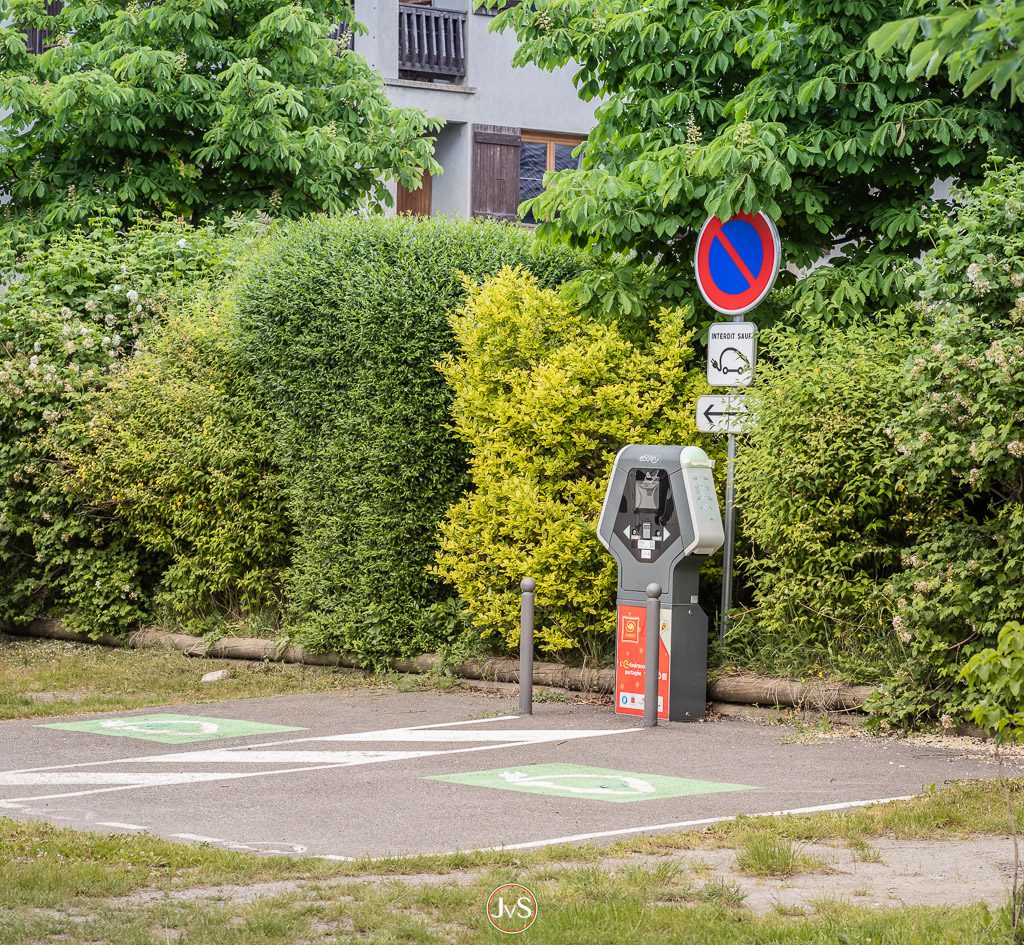
The Provence region is also almost completely littered with Type 2 charging points. In almost every village, even the most remote ones, there are charging points where the Model 3 can draw electricity at 11 kW. Fast DC chargers are more sparsely distributed, but there are also more than enough of them.
„Why not go south in a convertible?“ Well, with temperatures expected to be around 40°C, it’s too hot even in a convertible. No one wants the shock of sitting in a mercilessly heated car. Besides, I can’t get my head around the idea of cooling an open convertible with air conditioning.
The next advantage of the Model 3 is that it has overheating protection, which keeps the interior temperature at the desired value when the car is stationary. Before driving, it can be cooled down further via the app. The heat pump draws negligibly little energy for this. WHAT a comfort feature!
The return journey went over the French and Swiss Alps, with overnight stops at Col du Galibier and Furka. The massive torque, which is brought to the road without a hitch, made driving over the passes a pleasure. The car recuperates powerfully going downhill. A large part of the energy consumed when driving uphill is recovered. This was celebrated on the following passes:
Stelvio, Umbrail, Ofen, Flüela, Reschen, Timmelsjoch, Gampenpass, Mendelpass, Brezer Joch, Hofmahdjoch, Col de Larche, Montgenevre, Col d’Izoard, Col du Lautaret, Col du Galibier, Col du Telegraphe, Mont Ventoux, Col de l’Homme Mort, Col de la Forclaz, Furka, Grimsel, Brünig, Oberalp, Maloja, Arlberg.
Also in the early summer of 2023, the Model 3 saw the south of France – the journey went across the Maritime Alps and along the beautiful Côte d’Azur to the Camargue. We then saw the Cévennes and enjoyed the Luberon on the way back. It turned into 4000 kilometres in a fortnight, all easy, smooth and comfortable.
Consumption
and range
I drive the Long Range version of the Model 3 with a range of 602 kilometres according to WLTP. I don’t dare go that far, because getting stranded with an empty battery would be stupid. Of course, the car has a reserve – even with all displays set to zero, it can still drive a few kilometres. I have covered distances of around 550 kilometres several times. The lowest battery level I saw was 8%.
On the daily commute (60 km, 350 metres of altitude), the car consumes 8% of the battery charge in summer and 11% in winter. The higher winter consumption is mainly due to preheating twice. Important to know: At more than 85% SoC, recuperation is limited; at less than 20%, guard mode and pre-air conditioning are deactivated.
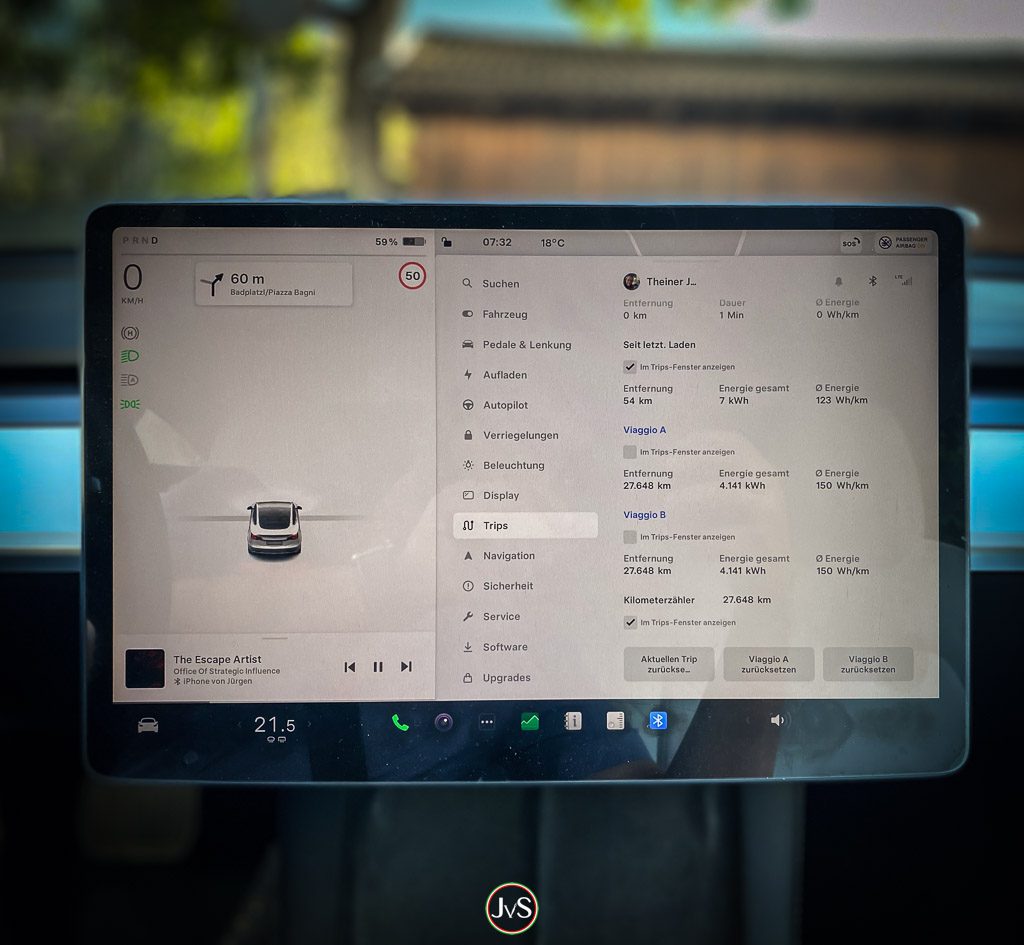
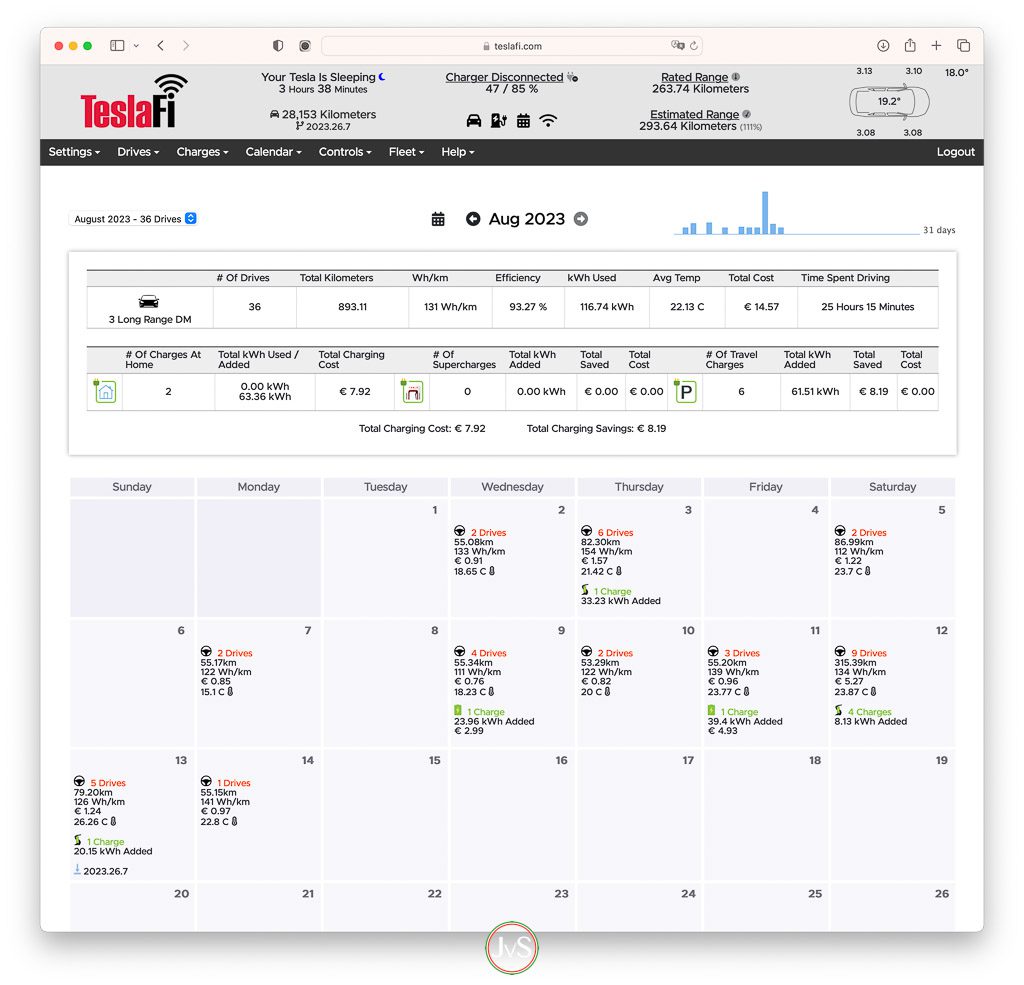
As of August 2023, I have consumed an average of 150 Wh/km over approx. 28,000 kilometres – according to RechnerOnline, this corresponds to a consumption of 1.5 litres of diesel per 100 kilometres. That’s nothing to complain about.
Great
things
At first glance, the use of the car is confusing because most things are not learned – and at second glance, it is ingeniously thought out. When the paired SmartPhone approaches, it unlocks: No more fumbling for a key, no more fretting about empty transponder batteries, no more hearing the rattle of a bunch of keys in the car. The tray in the centre console charges current SmartPhones wirelessly, huge storage compartments are elegantly hidden, the view to the front is unobstructed, the all-round visibility unsurpassed.
With one step on the brake pedal, the car is ready to drive, the driving gear is selected on the steering column lever. Ultrasonic sensors show distances to the nearest centimetre. When resetting, a crisp image from the high-resolution cameras appears on the 15-inch display. The display controls EVERYTHING. Two metal wheels on the steering wheel control cruise control, distance to the vehicle in front, media playback – and much more if desired, because they can now be programmed individually.
The car brakes automatically when manoeuvring is tight – successfully tested. Compared to all the cars I have driven so far, it feels like it is screwed to the road, even though Americans are said not to be able to build chassis at all.
The voice control has worked flawlessly so far. The air conditioning reacts within seconds and uses the heated seats and steering wheel for cosy warmth in winter. The quality of the premium sound system is top-notch, even if it sometimes rattles somewhere when playing proper progressive metal. The huge glass roof and the fireplace hidden in the depths of the software provide romance. The luggage compartment in the front of the car, the so-called frunk, is a charming gamechanger: pizza transport becomes possible without odours in the interior. The guard mode deters offenders, and the fact that the car can emit fart noises … well 😉
Sensational: the car requires virtually no maintenance – neither oils nor filters need to be changed, refilling combustion products such as AdBlue, exhaust emission tests or error messages due to full particle filters or dead NoX sensors are history. Regularly sweep over the white interior, keep an eye on the windscreen wipers and pollen filter – that’s all there is to it.
With each update – a good dozen by now – bug fixes and new functions are pushed into the car. These range from new camera views and activation of the steering wheel heating to individual assignment of the steering wheel buttons, new info views and multimedia functions. All this happens without hangs and crashes, simply overnight – and of course also app-controlled if desired.
Not so
great things
Where there is a lot of light, there are shadows. My Model 3 keeps annoying me by not recognising my SmartPhone. Although the car unlocks correctly, it logs the wrong driving profile with inappropriate seat, steering wheel and rearview mirror positions. A tap on the display changes the driving profile immediately, but it is annoying.
The emergency lane-keeping assistant can be deactivated, but this has to be done every time the car is driven. I would like to permanently dispense with the car’s rough steering interventions when bitumen is applied lengthwise or when approaching a solid white line.
No trailer coupling was available when the order was placed. As soon as the car was delivered, the corresponding option reappeared in the online configurator. Annoying: Retrofitting is apparently not possible.
Already on the first kilometres, a grinding noise from the direction of the driver’s door was disturbing. It was not reproducible and so quiet that it could not be heard on a video. A few skilful manoeuvres by the technician on the B-pillar made the noise disappear, but less than an hour later it reappeared and continues to delight me. Probably not a bug, but a feature?
Specials
& cool stuff
At the beginning of 2023, I created an account with TeslaFi. Since the data stream flows to Tesla anyway, I can also use it for interesting insights into e.g. driving and charging statistics, efficiency of my driving style, differences in consumption depending on weather, altitude and more. A nice gimmick.
Charging
at Home
Hours of standing time while charging – if you could find a free and functioning charging station. But you’ll only find them in industrial estates or in dodgy corners. At least that’s what Diesel-Dieter and Petro-Peter think in the social networks where people have real ideas.
„My“ charging station is 500 metres from home, within sight of the bank, post office, supermarket, café, supermarket and butcher’s shop. It only delivers 75 kW, but it’s almost never used by anyone. There are four more charging stations within a radius of 15 kilometres, including faster ones.
The car also charges in the garage at home on the Schuko charging brick, thanks to a specially laid supply line, appropriate fuse protection and a suitable socket – without any problems. Even after hours, the plug only gets warm, so the house has never burnt down.
Charging
on the Road
Tesla’s SuperChargers and the less conspicuous Destination Chargers (delivering 11 kW) can be found everywhere. Rarely in rural areas, but always where traffic arteries cross. So far I have charged in Affi on Lake Garda, Piacenza, Turin, Nice, Avignon, Le Caylar, Orange, Sisteron, Martigny, Innsbruck and Sankt Moritz, always according to the principle „plug in – done“.
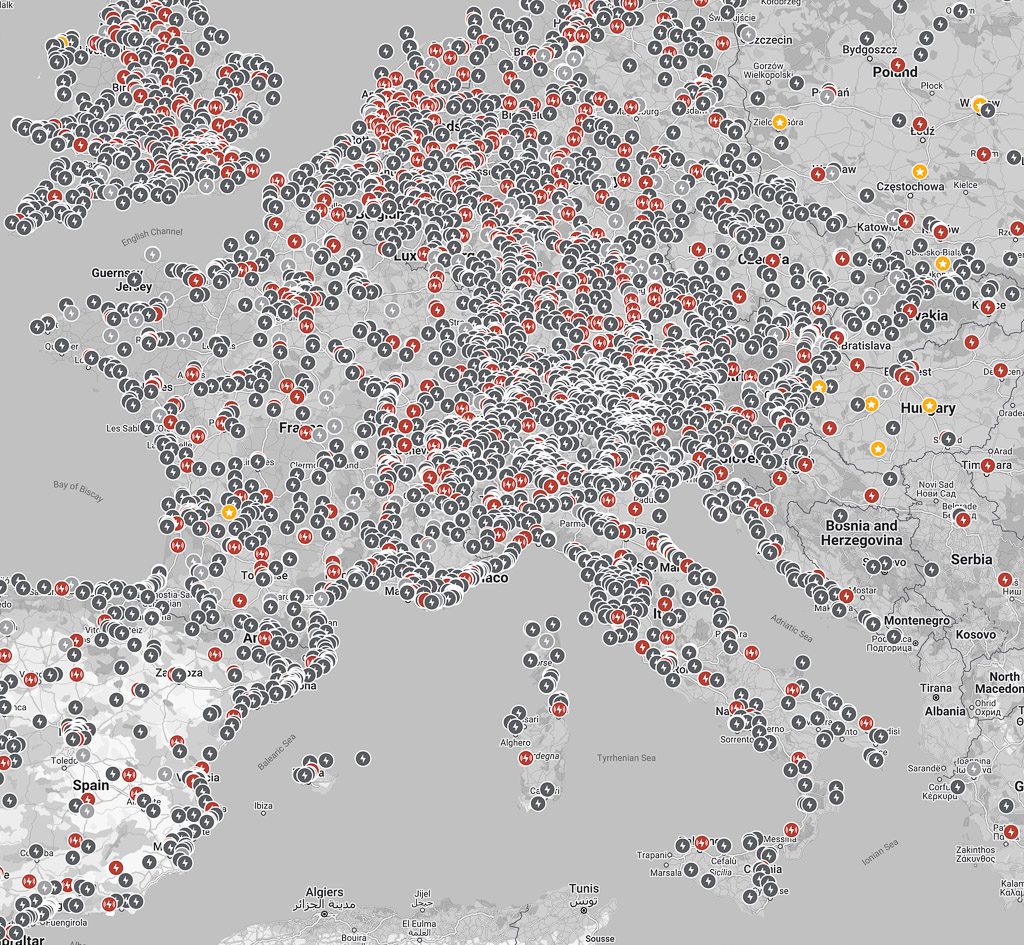
In addition to Tesla chargers, there are plenty of charging points from other providers. According to the Federal Network Agency’s charging point register, there will be around 74,000 normal charging points and over 16,600 fast charging points in operation in Germany by 1 May 2023.
In the meantime, I get by with three charging cards: Enel X Way and Be Charge in Italy, Chargemap in France. With these, I was able to activate and use every charging station I came across.
What
happens next?
The Model 3 will stay, of course, because the topic of combustion engines at MotorProsa is over. Apart from the less cool things mentioned above, the car lacks nothing. There are constantly new features that keep the vehicle attractive. It already covers all requirements: comfortable commuting, short weekend trips, long-distance holidays. The energy and running costs are low, wear and tear on relevant and expensive components is not to be expected, so: Ride on!
Technical
Data
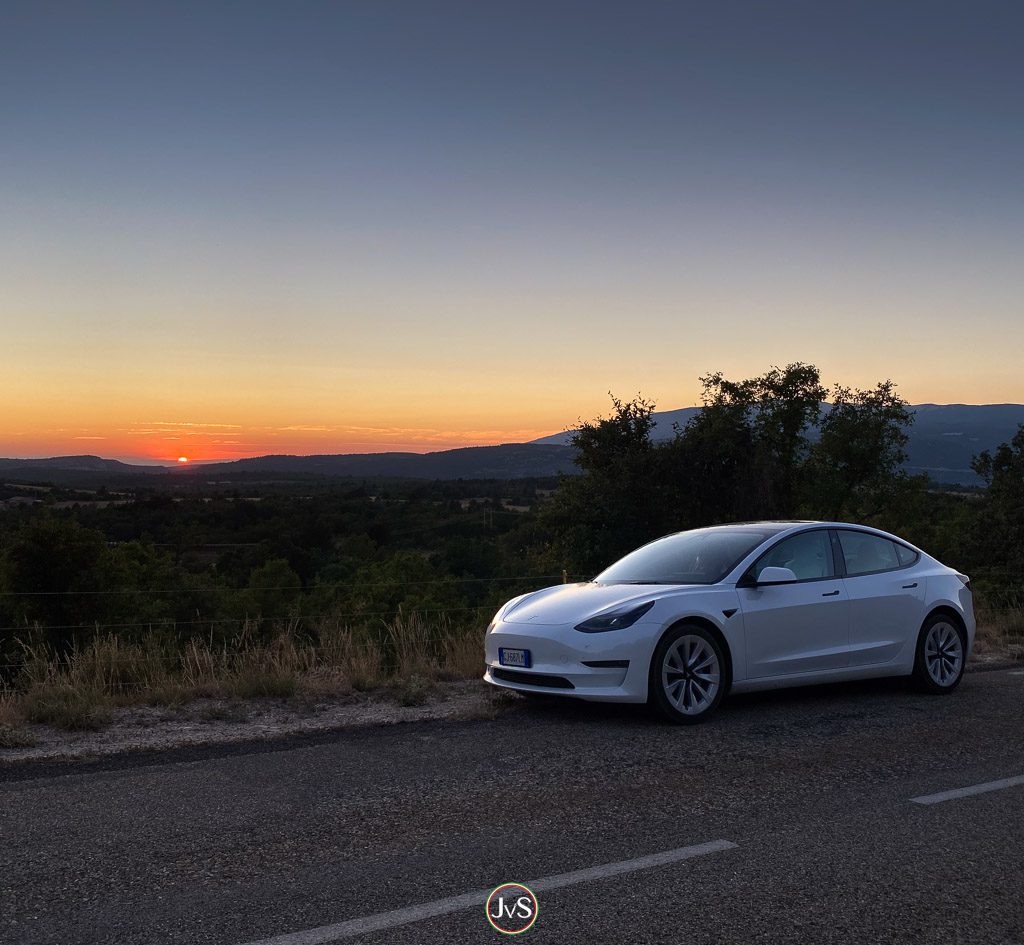
Tesla Model 3 Long Range with Dual Motor, All Wheel Drive and Autopilot
Pearl White Multi-Coat
Black and White Premium Interior
19’’ Sport Wheels
366 kW / 493 Nm
0 to 100 km/h: 4,4 Sec. / Vmax: 235 km/h
Battery: Lithium Ion – 72 kWh (usable)
Max. charging speed: 210 kW DC
You can find more details in the EV-Database.
MotorProsa-Glossar
for ICE drivers
- SoC?
Abbreviation for „State of Charge“, i.e. the charge level of the battery. It is usually kept between 20 and 80% to conserve the battery.
- Watt? Kilowatt? Kilowatt hours?
The amount of energy stored in the battery is given in kilowatt hours (kWh), as is the consumption per 100 km. In the case of my Model 3, this means 72 kWh battery capacity or an average consumption of 15 kWh/100 km. Theoretically, this results in a range of 480 kilometres.
The charging capacity of a charging station is specified in kilowatts (kW). Theoretically, „my“ charging station with 75 kW would need just under an hour to fully charge the empty 72 kWh battery. However, the charging power is not constant: the fuller the battery, the slower it can absorb energy. Only a HyperCharger with 150 kW or more peak power can do the job in 20 to 25 minutes.
- Recuperation?
Electric vehicles with recuperation recover energy during deceleration, which has a positive effect on the range. Depending on the strength of the recuperation, the need for „normal“ braking can be eliminated. The Tesla Model 3, for example, can drive from the Stelvio Pass into the valley without using the brakes and recharges by about 4 to 6%.
- AC? DC? CCS? Typ 2?
The interplay of direct current (DC) and alternating current (AC). Hanging on an AC charging pole, the charging technology installed in the car ensures that the battery gets its direct current. Typically, AC charging stations deliver up to 22 kW of power, the Model 3 can take 11 kW. So it takes a little longer: good for restaurant visits or shopping.
DC charging columns fire direct current into the battery. All the technology, including the cooling system, is built into the charging columns, which currently enable charging outputs of up to 400 kW. The waiting time at a fast DC charging station is rarely more than 20 minutes. Bad for restaurant visits or shopping.
The slow AC charging stations rarely have a fixed charging cable, so you should have a suitable cable with the so-called type 2 plug with you. The fast DC HyperChargers have permanently mounted, much thicker charging cables with the CCS plug.
- Frunk?
Since an electric car has neither an internal combustion engine nor its appendages (radiator, gearbox, even more radiators) and an electric motor is much smaller, there is suddenly a lot of space under the bonnet. Some – not all – models use this space for the „front trunk“.
Perfectly matching:
Electric motorcycles – fact check in the Alps

Energica Ego – New Motorcycling

Bullet Brake, or: Your motorcycle brake can do more

Zero SR/F: The Electric Way of Drive
Verge TS Pro – The Trigger Donut