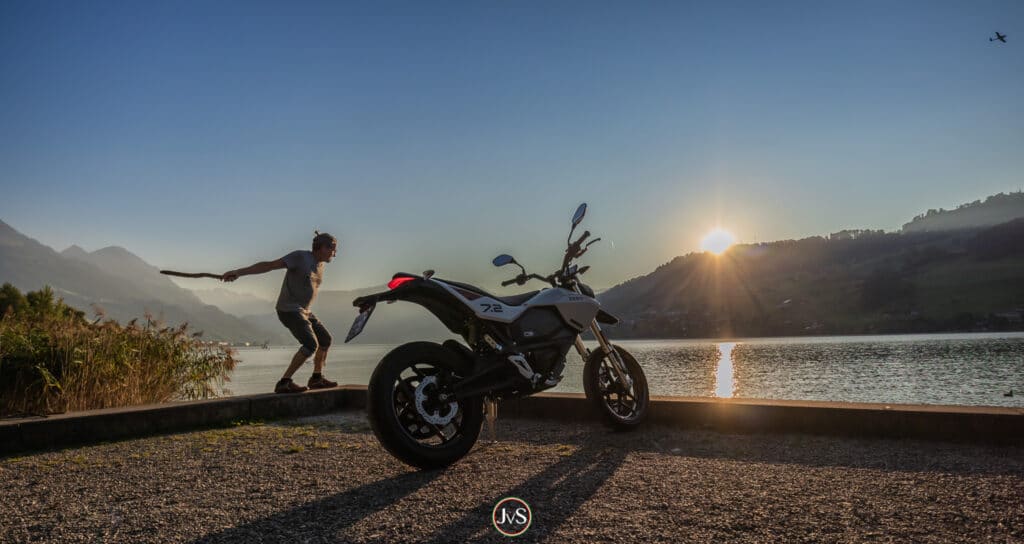
Time to throw the old ways overboard – with quirky memories of my noisy supermoto past, I get to ride the “motorcycle of the future” in the heart of Switzerland: My impressions of the new Zero FXE.

Before you read, please note: this post was translated with the help of Deepl.
If you find any errors – please have fun first and then give me a hint.

I borrowed the Zero FXE for this story from Country Road Alpnach, the Zero dealer for central Switzerland. Many thanks for this!
My motorcycle roots lie – unbelievable – in the supersport scene. Deep stubby handlebars, thigh-spreading tanks and pain everywhere as a constant companion have left their marks on me.
Then, around the turn of the millennium, the supermotos came into play. Rough and loud single cylinders from Mattighofen pushed my dynamic world view into crazy lean angles and vertically upwards. I celebrated fun in every bend.
It ended when it was at its most beautiful – 2008 I made my last wheelie. My KTM LC4 625 SCSM burned itself so deeply into my heart, riding it for over 40,000 hot-rodded kilometres, that it would still be my favourite toy today.
It had to give way – despite all the love – to a pushchair for my new born son. Could be worse.
Good
ol’times …
Today, there are no more motorcycles of this type – exhaust gas and noise regulations prohibit them. OK, that was already the case in 2002, too, but back then it didn’t matter that my Supermoto stank louder than allowed. A few years later, the high-revving 690 in the KTM Duke III disappointed me so much that I don’t even want to ride the current SMR any more – even if I’d like to fling myself through tight bends with my elbows high and my leg stretched out.
More than once my 625 sputtered petrol over the triple clamp when braking hard, and more than once the fierce backfire of the open exhaust gave me a persistent whistling in my ears. It wasn’t all better in the old days. But it was definitely different.
The Motorcycle
of the Future
Now, according to Zero, the future has begun – and puts an electric supermoto with a novel design onto the market. The key for the only Zero FXE in Switzerland at this time hangs casually on the finger of Isa, owner of Country Road, the Zero shop in Alpnach. She entrusts me with her brand new and beautiful machine – and I am very happy to thank her for it!
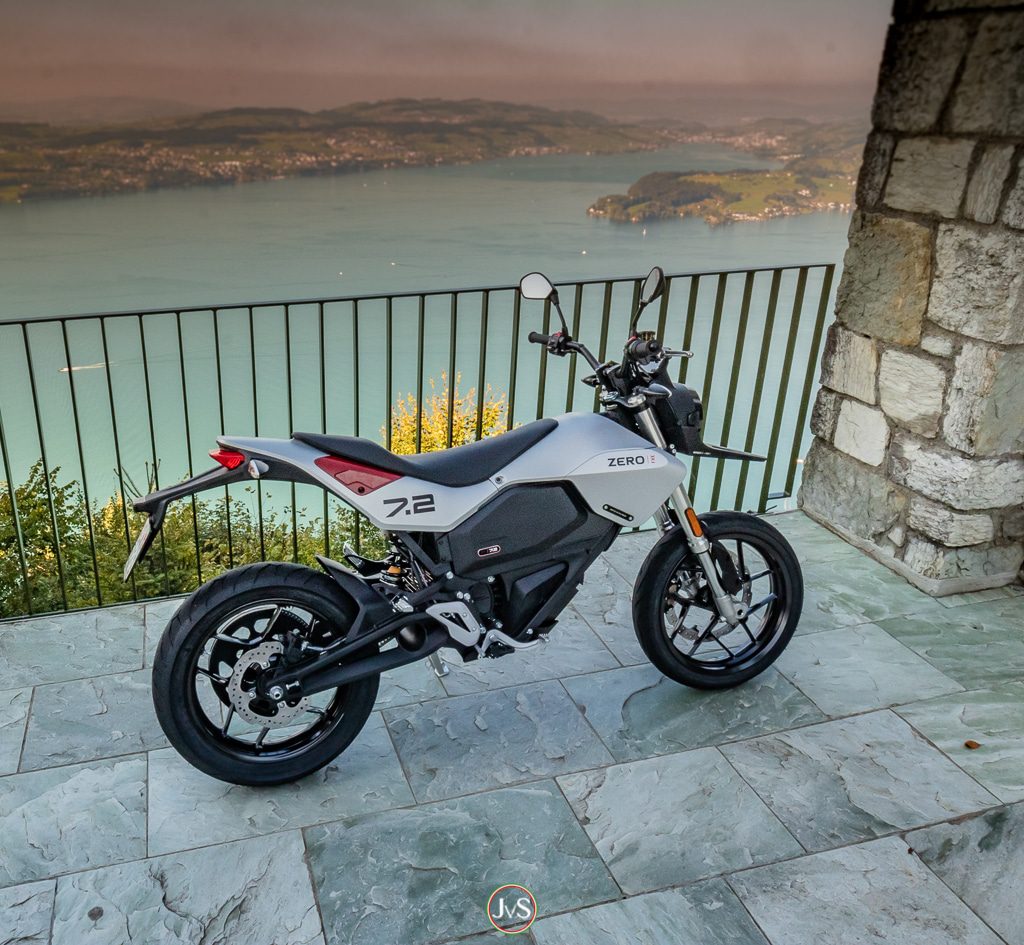
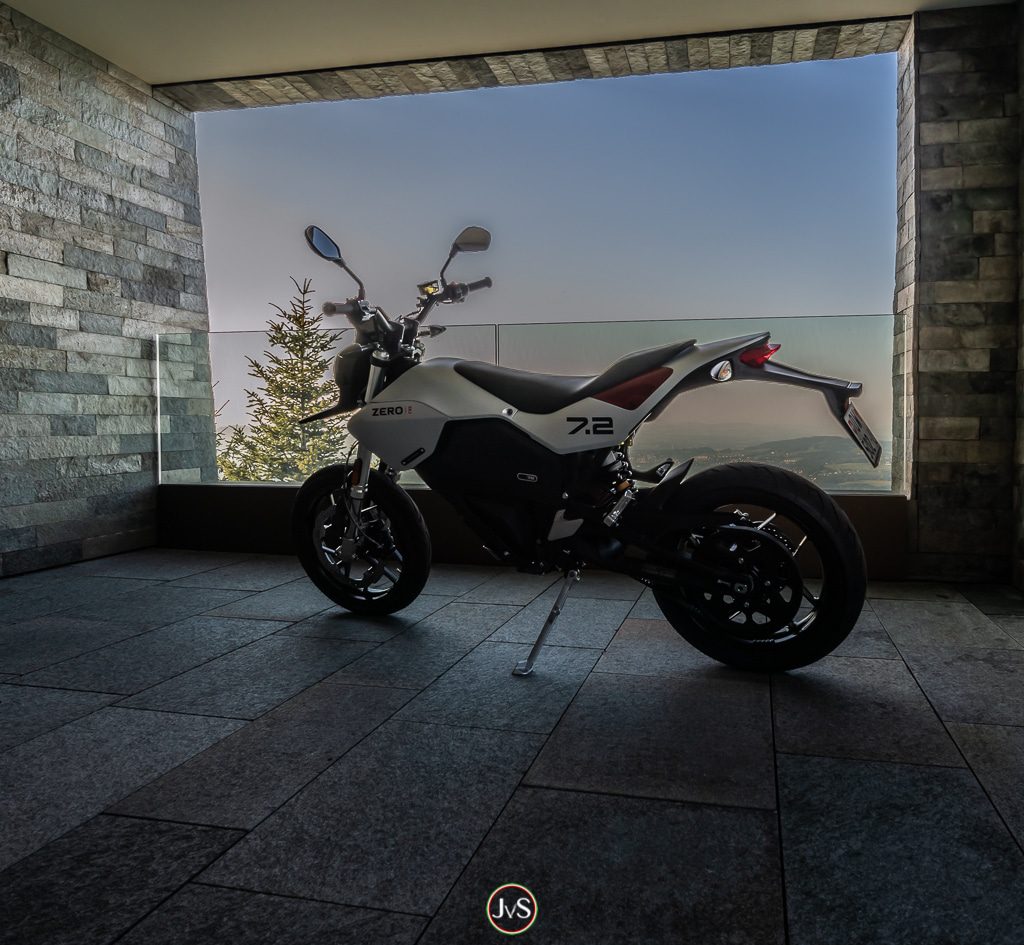
All new, all beautiful – especially in real life: the Zero FXE
Beautiful – my KTMs were never that. I never liked any of them for their looks, performance was always the priority. But this bike, now shining silver in the sun, has something. Among other things, it has a beak above the front wheel, which at first glance calls for a conversion. It does so only briefly, because it looks good at second glance.
The FXE is based on the well-known FXS from Zero. This is no ugly duckling either – but the creative minds at Huge Design have transformed it into a swan. My gaze lingers on the curvy and smooth surfaces of the pseudo-tank as soon as I sit in the wonderfully flat and high saddle. No angular screw cap with oozing overflow disturbs the lower body approach to the handlebars, no tank spoilers fluttering merrily in the air disturb with gaps of death.
A noble look with beautiful touch quality. Like a modern smartphone, the full-colour TFT display in the cockpit is a delight – but it can’t prevent my question marks because of the cheap turn signals from the rummage box, and without LED technology.
At least, in the inevitable case – or if you get stuck with your cross boots – only a few euros go over the workshop counter for replacement turn signals. That was always an advantage with my KTMs, too.
Insane
Power
The ZF 75-5 engine in the aluminium frame surprises me with its unusual and rough sound. My own SR/F rolls along much smoother and quieter, creamier in comparison – but after just a few metres I get used to it, because the DSR, on which Isa is riding ahead, sounds almost the same. The FXE is unbelievably light and easy to manoeuvre around manhole covers, the avoidance of imaginary obstacles in the roadway happens in a flash, as if controlled only by thinking about it. My ultra-fun SR/F, which I rode over 1,500 km through central Switzerland in the days before, is much more front-heavy and – sounds bad – sluggish.
The button that activates cruise control on my SR/F changes riding profiles on the FXE. It’s a supermoto, and it calls for sport – 106 (!) Newtonmetres instantly entering the rear tyre and a handlebar tugging hard on my arms completely redefine the supermoto sensation I know.
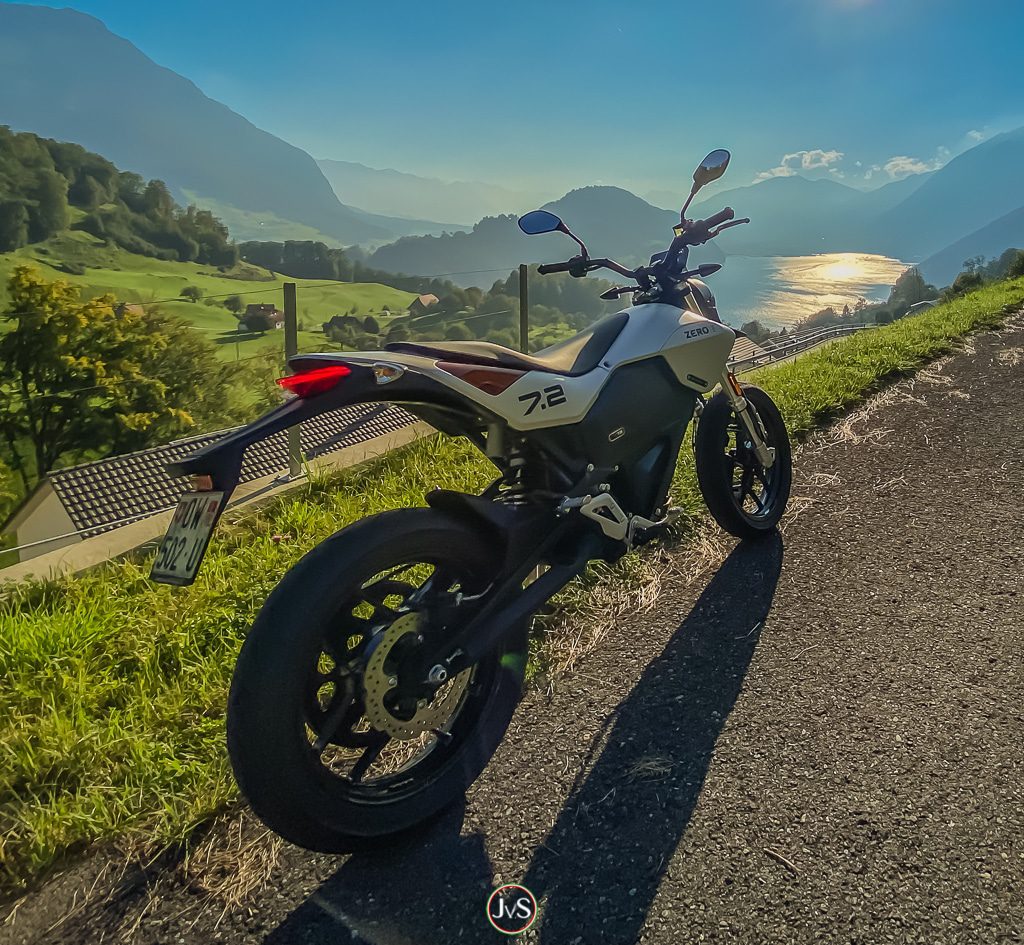
The Zero FXE should make a big impact on the supermoto scene
THAT guarantees a place at the front of the action on corner exits, whether in the kart hall or on the supermoto track. The FXE will tear past the stomping single cylinders of the past with their rarely more than 70 Nm whistling, and with a casual twist of the right handle. The FXE does not require desperate gear sorting with rough cross boots or permanent dialogue with the clutch lever, and the rear wheel stamping during cross braking, as an unmasking of a lack of riding skills, should also be unknown to the supermoto of the future.
How long this can be celebrated remains to be seen. But in my fading memory, I was always sufficiently softened up after 20 minutes of track fun. If a power cable can be connected to the FXE during rider recovery breaks, the 7.2 kWh storage battery will easily allow for a fun day on the track.
Exciting, in the sense of “Where will I get stuck?” should be a Stilfserjoch attack in JvS style. They always come down, even with a dead battery. Nevertheless, it would have been nice to have a thicker charging option to be able to recharge a few kilometres along the way. Unfortunately, the necessary trappings for Type 2 in the FXE, including the charging cable, would work against the current and sensationally low weight of only 135 kg, but the meagre 650 W that drip into the battery in the standard configuration condemn the empty Zero to the garage at night.
But friends, again to read along:
106 Nm, 135 kg –
this is
the new fun on the street!
I do not know anything about suspension. The magical interaction of springs, dampers and oil doesn’t quite make sense to me, even after 30 years of motorcycling, so I ride my bikes as they come out of the shop. On the ride to Bürgenstock, high above Lake Lucerne, the FXE doesn’t ask me any questions. It swings through the curves without any disturbing sensations, cushions the few bumps in the road – after all, we are in Switzerland – unobtrusively. And I simply believe that an inconspicuous chassis is a good chassis.
If you like, you can of course give the FXE a fully behavioural suspension: the upside-down fork and the shock are fully adjustable.
Unsurprisingly, the FXE is not only fun to ride up the mountain, but also wonderful to ride back down. It is easy to slide forward on the seat, and with the resulting pressure on the front wheel, illegal lean angles in the serpentines come all by themselves. The brake has relatively little to do in Switzerland mode because of the engine’s recuperation function, but would no doubt make for enjoyable stoppies. I’ll test that another time, because Isa has me alert in the rear-view mirror. Besides, the Swiss fine catalogue demands a relatively large amount of play money for such feats …
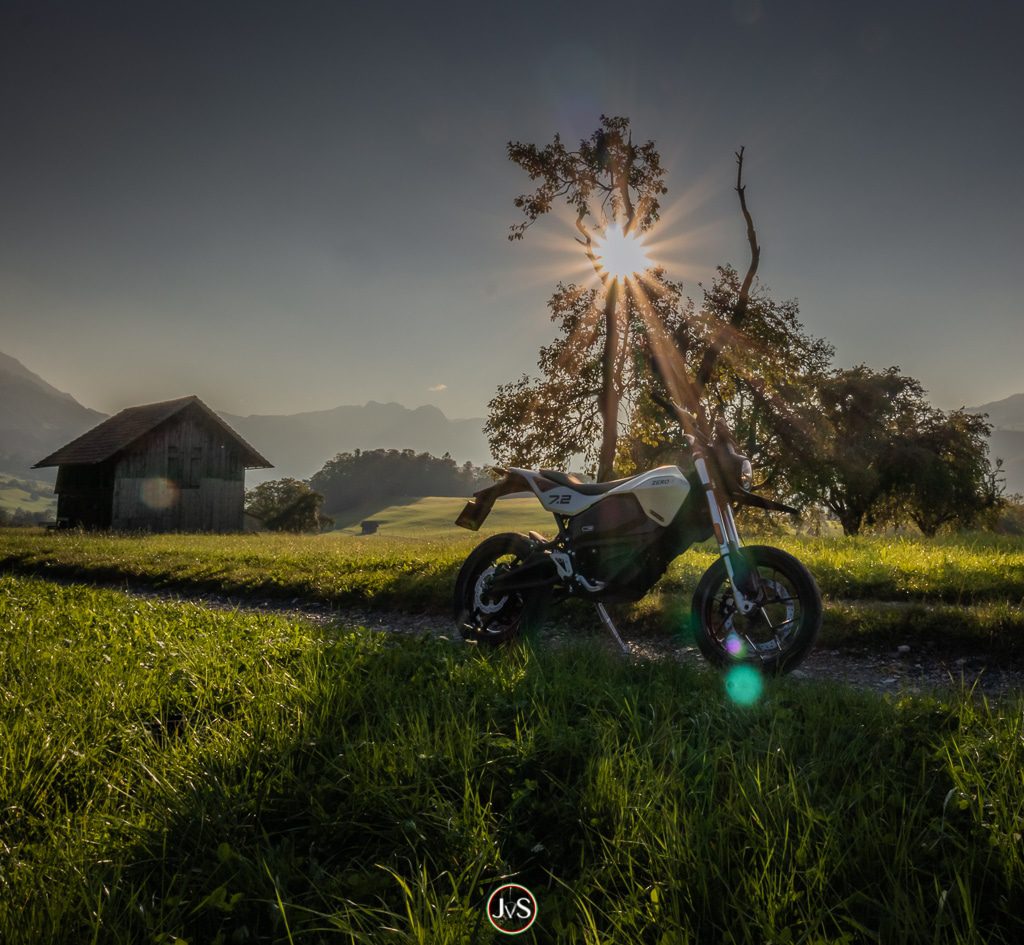
Possible, but not necessarily the perfect surface for the Zero FXE
Supermoto also means off-road – and there is plenty of off-road in the Alpnach hinterland. Of course, the Diablos feel very strange on grassy dirt roads, so I leave it at a short photo intermezzo in the shade of a Swiss alpine hut.
During the lap of honour around Lake Sarner, with a view of the distance travelled so far and the remaining range calculated by the software, memories of my 625 KTM come flooding back. It had a dead display and a 9-litre tank above its rattling single-cylinder, and immediately started boozing when fighting the bends with cheeky litre bikes. My record is still five fuel stops in one day – the KTM rarely got further than 120 km.
The FXE can easily manage 120 km at a stretch. But not five times in a row – that’s not bad, because I would fail at that too by now. But, and this is wonderful: fiddling with greasy oil cans, filters and always slipping sealing rings, as was necessary with my 625 every 1,500 km – that is history. The only maintenance the FXE requires is checking the brakes, air pressure and the tyres, and thanks to the toothed belt you don’t even get a sticky rear wheel because of the chain spray.
For the last photo stop, I roll back to the shore of the beautiful Sarn Lake – very illegally past official bans, over gravelled pedestrian paths, between trees, over well-kept lawns, with friendly greetings for dogs catching sticks. No one is bothered by this, I remain untroubled by nasty looks. On the contrary, I am happy about several thumbs up.
So the motorcycle of the future is also changing non-motorcycling fellow human beings and is always and everywhere arousing interest in range, charging times and price. This never happened to me with my oil-dripping, rattling supermotos of the past.
Allows a lot more than “normal” motorcycles: the Zero FXE
In the last rays of sunshine, I stand in front of the Country Road shop and let my eyes wander once more over this really beautiful motorbike. In my mind, a wicked brake system is fitted to the front wheel, including a radial brake pump. The massive side stand would immediately be history; its weight would be taken over by aluminium Supermoto crash bars on the handlebars. Then two “Supermoto Syndikat” stickers on the plastic on the left and right, done!
Perfectly matching:

Energica Ego – New Motorcycling

Zero SR/F: The Electric Way of Drive

4 weeks Zero SR/F – Nix? Nada? Niente?

Bullet Brake, or: Your motorcycle brake can do more

An electric journey through Switzerland


Very nice review (I owned an FXE in Paris)