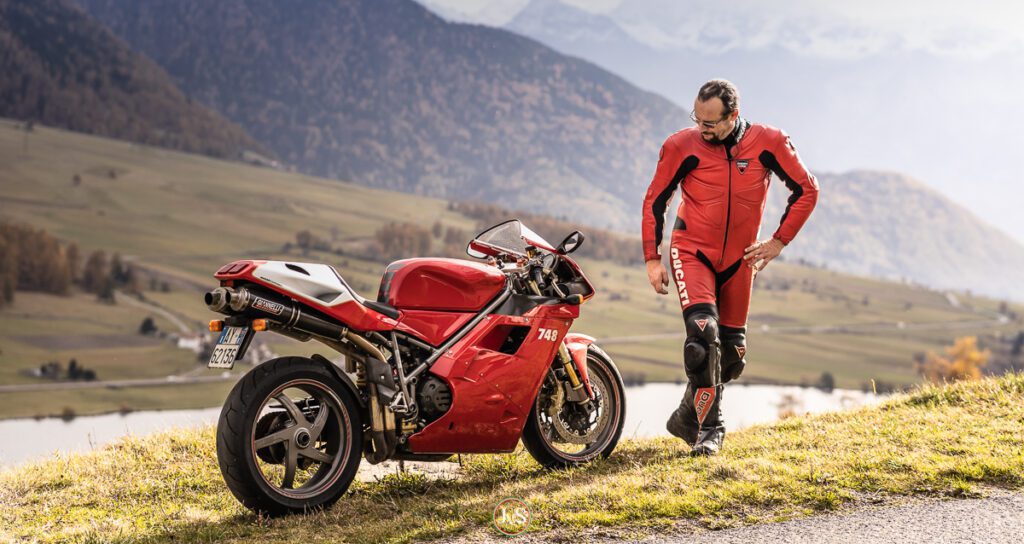
I admit: My Ducati 748s hasn’t quite reached 100,000 km yet – but it will reach this milestone in spring 2025. Before the Tamburini is winterised in the next few days, I look back on our eventful 24 years together.

Before you read, please note: this post was translated with the help of Deepl.
If you find any errors – please have fun first and then give me a hint.
In the mid-1990s, a small Italian factory turned the motorcycle world upside down. The armada of pot-bellied, towering, asymmetrically exhausted four-cylinder sports bikes from Japan, all of which followed the same construction pattern, was shaken up by a slim, small bike.
It was radically different in form – and radically thought through to the end. Headlights with a feline look. A filigree but bombproof tubular steel frame enclosed a slim, supportive engine. The cockpit was drawn painfully tight around the handlebars, guaranteed to pinch thicker fingers. The back of the fuel tank as the narrowest point of all. Crash-protected exhausts at the rear. A single message: Where I am is up front. Quick-release fasteners, single-sided swingarm, completely naked in minutes. All designed to keep you smiling all the way to the chequered flag. As the first, of course.
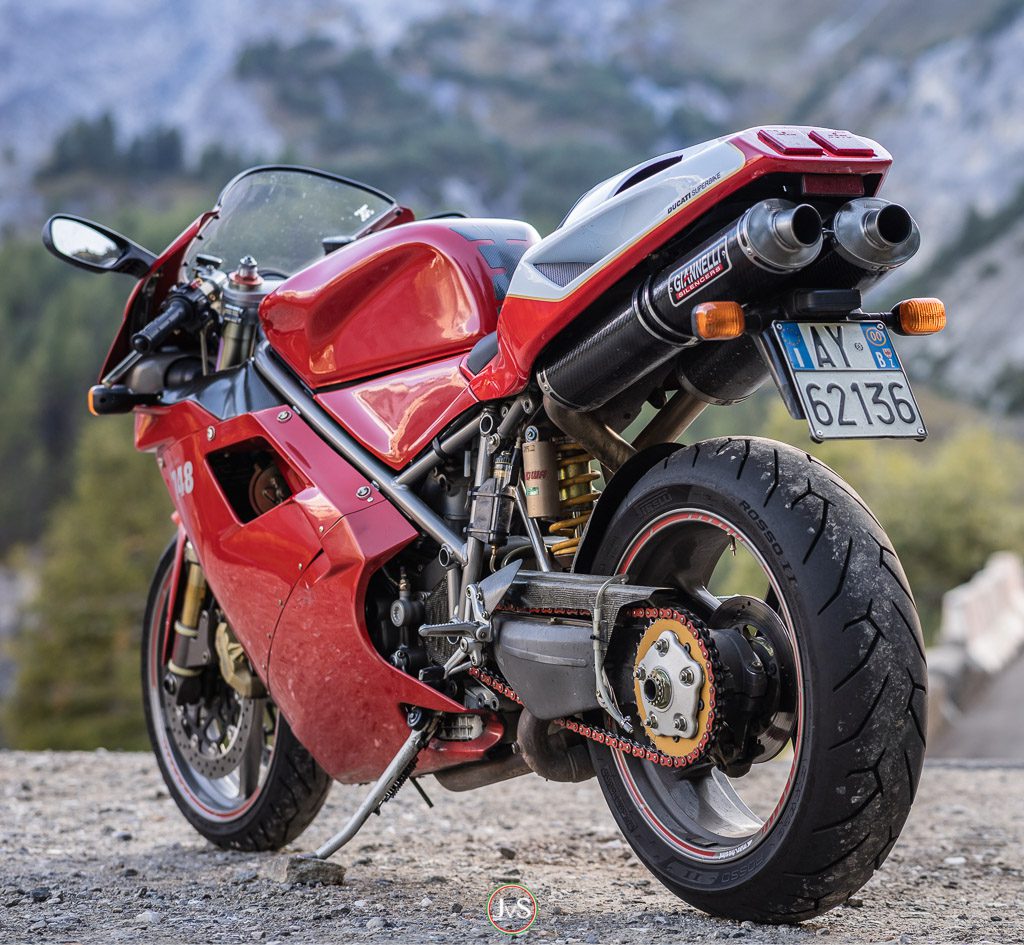
My Ducati 748s in autumn 2022
The Ducati 916: a century design, specific for the race track and revolutionary in its consistency. The sensational Honda RC30 was undoubtedly the template for “la moto massimale” in Bologna, but the 916 combined Far Eastern precision with Italian madness.
This also meant: the 916 was not available for a long time. Hundreds of half-finished bikes remained in the factory because suppliers had stopped delivering due to unpaid bills. Organised chaos and a sometimes very casual build quality kept many 916s off the road. Apart from the price.
My first contact with the goddess was in the saddle of a Yamaha FZR 1000 Exup – a battleship compared to the red one from Bologna. I followed the Ducati through the Vinschgau valley, it filled the space behind with harsh Termignoni fanfares, terrifying clutch rattles and its orgiastic tail. After a few kilometres the 916 crashed sideways into the rear of a car taking the right of way, leaving the rider with a broken wrist. The Ducati, on the other hand, was able to roll home on its own wheels thanks to cleverly placed predetermined breaking points on the handlebar stubs, clutch grip, mirror and fairing brackets.
That had never happened before.
The 916 was fascinating, but for a long time I did not feel I wanted it. Its radical looks spoke against it, I was still more addicted to the superbikes of the 1990s: GSX-R, ZXR, the beautiful OW-01. What’s more, its successor, the 996, even in 2000, was still priced in spheres I couldn’t reach. However, I spontaneously fell in love with a 748 that I could practically see being born: During my visit, my dealer opened a crate from Borgo Panigale and assembled the “little one”.
First contact
with the Ducati 748s
Barely six months after that impression, the keys to my Triumph Daytona changed hands and I climbed into the saddle of a Ducati for the first time. I rode it at night from Bolzano to Vinschgau, a distance of only 80 km. The high footrests gave me severe cramps in my thighs, the low handlebars burned my wrists, and the sluggish engine threw me uncomfortably against the hard fuel tank several times. Fortunately, family planning was not an issue. The thing rattled, clattered, roared loudly and dully, briefly:
It was so awesome!
After one day, I was already shaving the curves of the Reschenpass, proudly showing off the disappeared fear stripes in front of the ice cream parlour. That was something back then. The first 1,000 kilometres of running-in were behind me after a week, the mechanic in Imst (Tyrol) did the inspection. On the way back I almost drowned in a thunderstorm – my 748 passed the wet test without a murmur and from then on I never doubted the Italian electrics again.
It didn’t matter to me that the 916 and its sisters were built for the track – I was travelling with it. A tank cover with two rucksacks and a large rear bag served me well. One of the first longer rides took me to Franconian Switzerland – after a phenomenal festival of bends lasting several days, a well-packed family station wagon pushed my Ducati to the right into the coarse gravel at Kathibräu. Once again the predetermined breaking points proved their worth.
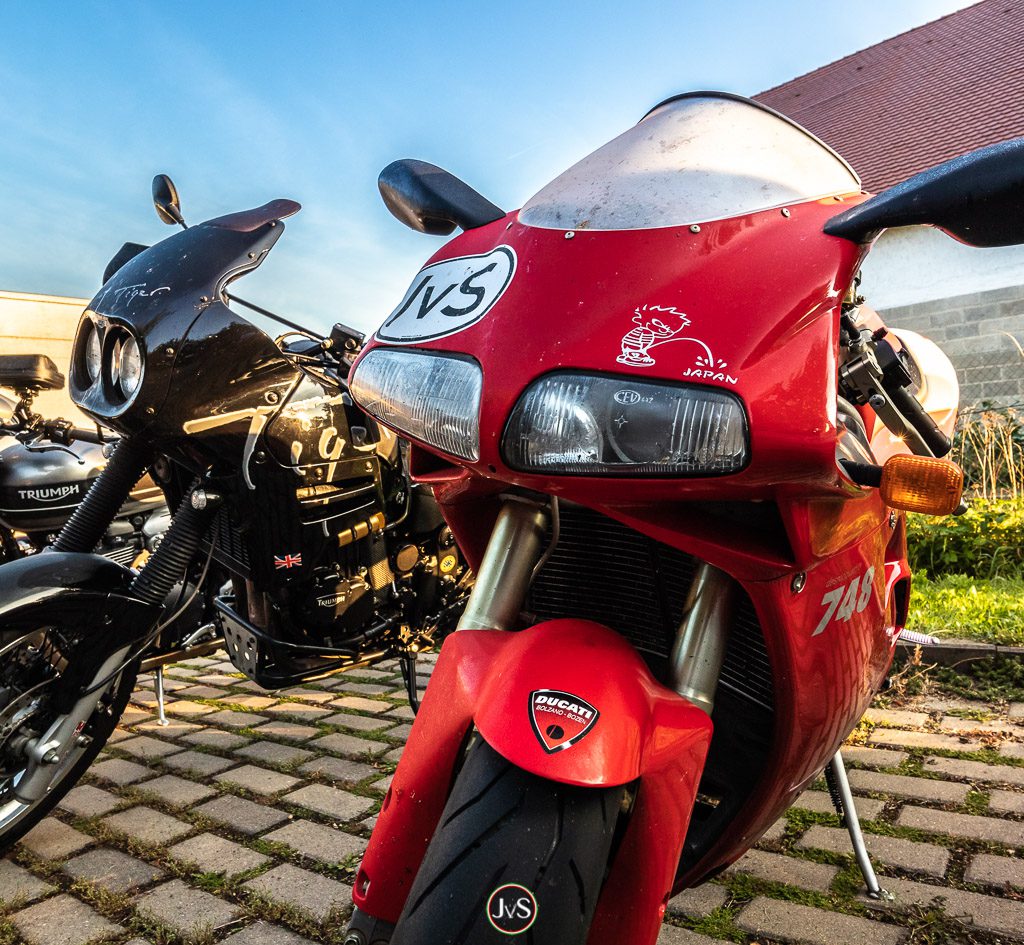
On the road with good friends in Franconian Switzerland
The next incident was not far behind – the following year I threw the fully loaded 748 I was riding to Denmark with a passenger in front of a German police patrol car. I was pushing the bike away from the pump after refuelling and stumbled over the side stand. It fell back on its right side, the predetermined breaking points … you know. We reached Denmark anyway and I got home without any problems.
After a year the mileage jumped to 30,000. I was running the third set of brake discs and the second set of rocker arms. The brake discs, which were supposed to be suitable for racing, were permanently warped, and the rocker arms in the Ducati heads had a tendency to separate from their coating. If it hadn’t been for the warranty, I would still be penniless today.
I pressed my knee sliders into the asphalt of the Anneau du Rhin and the Salzburgring, drove to the Ligurian coast in one go and back again the next day after some interpersonal difficulties. I regularly paid my respects to the Franconians – I still love the game in the bends between Bayreuth and Bamberg.
I rode the Ducati all year, through rain, snow and salt water, and looked after it manically. A tablespoon of my mother’s best washing powder mixed with hot water in a spray bottle kept the 748 clean and shiny. The second set of chains was fitted at 40,000 km to match the second clutch. Second hand from Ebay, as the budget did not allow for original parts. The service costs were always in four figures. And I drove a lot.
Again the 748 went down – but this time to the left, in the first corner of the Stelvio. I was sitting on a rare and incredibly expensive 916 Senna, watching the drama from behind. For once it was a good idea to change bikes, the Senna should not have fallen over…
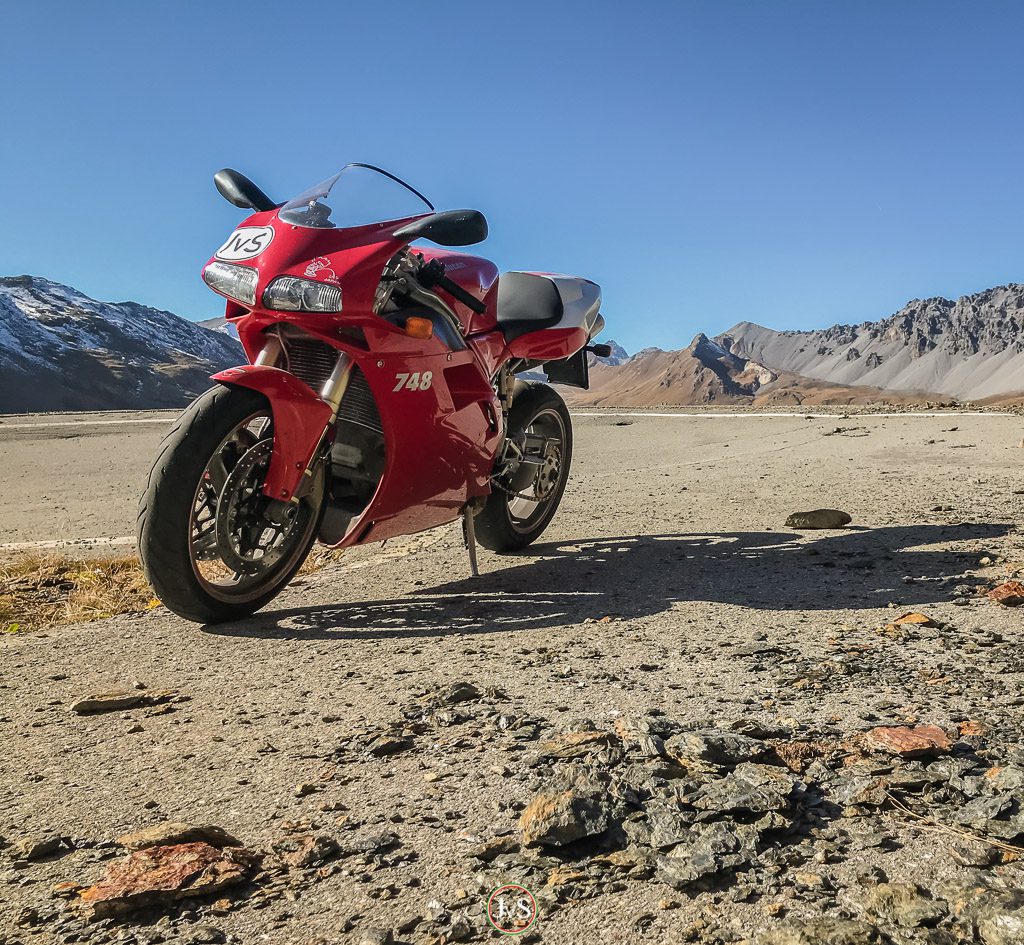
My Ducati 748s on its favourite playground: The Stelvio
Stilfserjoch, yes. The true playground of my Ducati. I can’t tell you how many times I’ve taken the 748 up and down the 48 bends, but it must be in the hundreds. The feeling as if the bike were bolted to the road, the absolute precision and the unwavering stability under hard braking, even on rough asphalt, that’s what gives me unbridled pleasure. The fact that the little one roars like a big one out of its intake nostrils gives me goose bumps. Again and again.
From 2002 my love for Ducati began to wane. I had hot affairs with three supermotos and the crazy scene that went with them. The 748 became a little-noticed commuter bike, used only between home and the Supermoto garage. It stoically endured short-distance bashing, didn’t whine about neglect and sparing use of mum’s washing powder, and even proudly bore the marks of outdoor parking – cue bird droppings.
From 2008 I hardly rode the Ducati at all – baby break. The 748 spent a year in a musty underground garage, then another under the too-short canopy of a Swiss family house. It was buried under metres of snow in the Grisons, and lay in the mud of the front garden when the spring thaw came. I tried to make up for it with a place in the living room, somehow …
And I thought about a separation. But who would want to buy a Ducati with over 50,000 km? I found no one.
In 2016, I hauled it on a trailer to Basel in Switzerland: the start of a sporting journey through the Vercors and into the Cévennes, with RR-BMWs and 1290 KTMs in tow. The mercilessly underpowered Ducati put up a brave fight, roaring through the gorges of the south more leaned than permitted and wearing out a complete set of tyres on the French tarmac this week. My old love has been rekindled, even if my shoulders, neck and wrists have been sore for weeks.
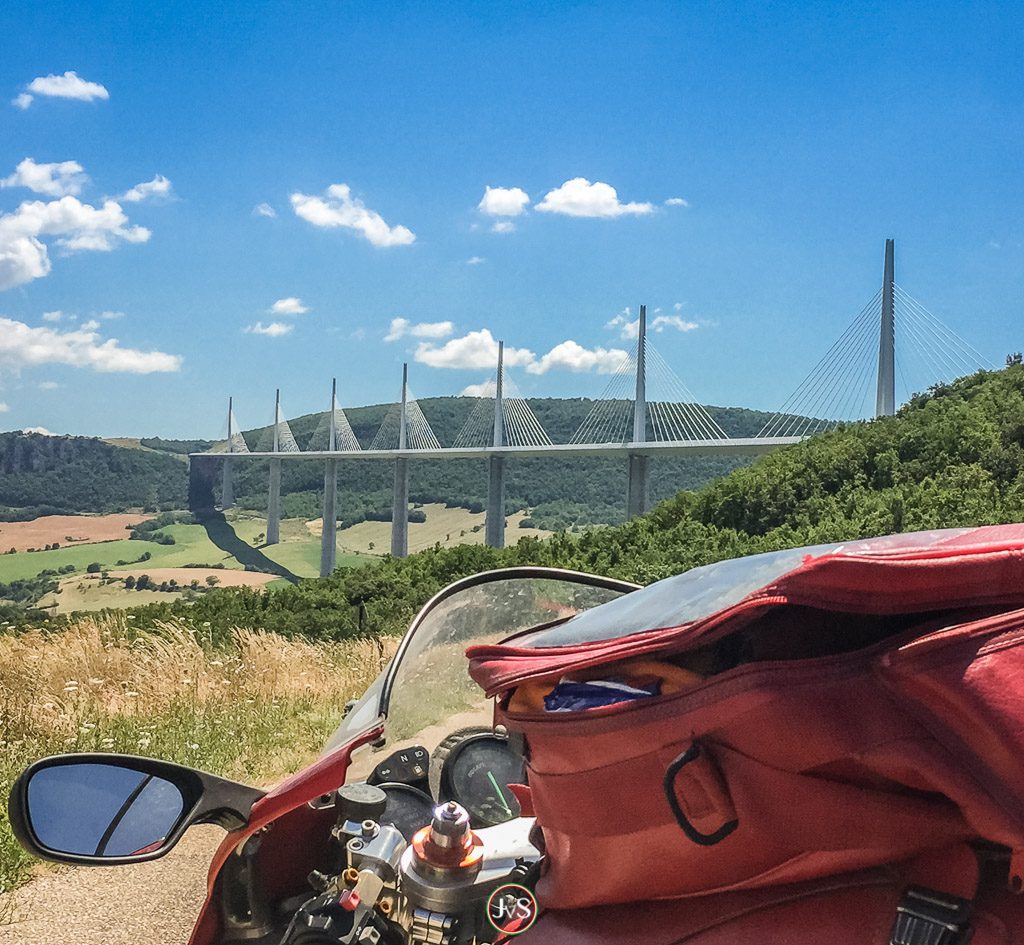
On a great ride: My Ducati 748s at the Viaduc du Millau
More and more modern motorcycles with ABS, internet and space technology moved into my garage: KTM LC4 690 Duke III. KTM 1290 Superduke R. Zero SR/F. Even a Harley Road King, can you imagine? But the Ducati held its own. With its shirt-sleeved, pointer-wagging technology, it is now the maximum antithesis to the hypermodern Zero. It wears the dress of the single-seater version, has upgraded brakes and clutch (radial pumps) and is regularly serviced by the mechanic who took it out of the transport box in the distant spring of 2000. The original exhausts have been replaced with strong carbon Gianellis, reminiscent of my very first moped, which I had also upgraded. And because I use it for travelling, it also has a Scottoiler.
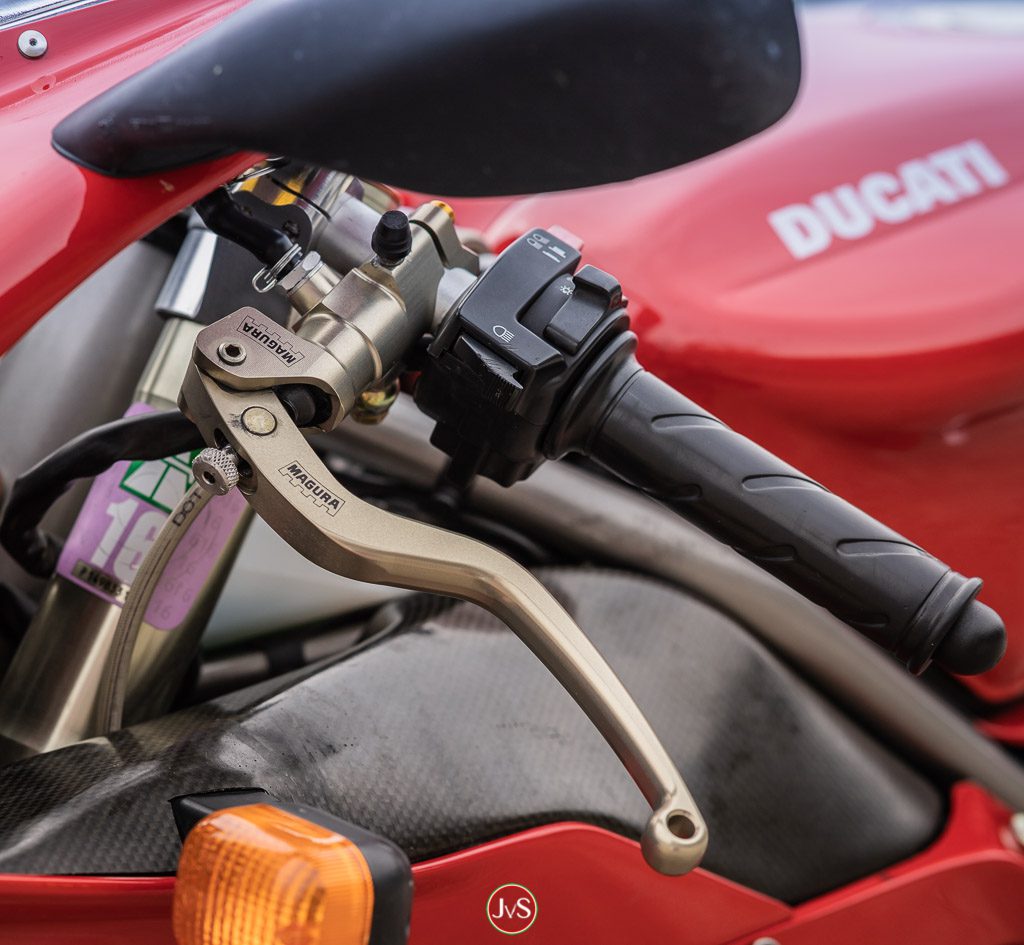
Fine brake components for the “small” 916
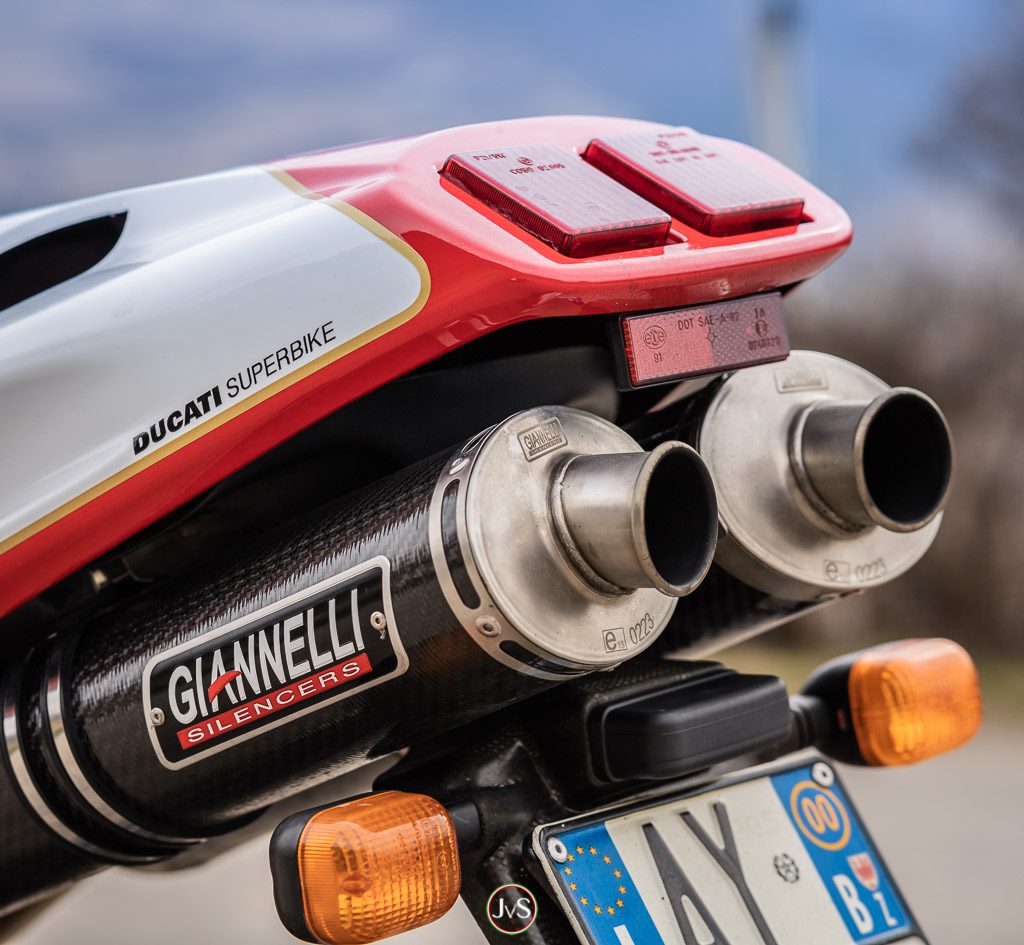
Reminiscence of my first “motorcycle”: Gianelli
It is, of course, demanding to ride, requiring the whole of the rider’s body to move forward dynamically. It has relatively little power – basically none compared to today’s litre bikes – and its now razor-sharp braking system leaves no room for error.
It bears the marks of 24 years and 95,000 kilometres. The carbon is dull and faded, the fairing keel sandblasted down to the primer. The rims tell of dozens of tyre changes, the ignition keys are worn and bent. And the curves of my body no longer fit elegantly between the tank and the seat.
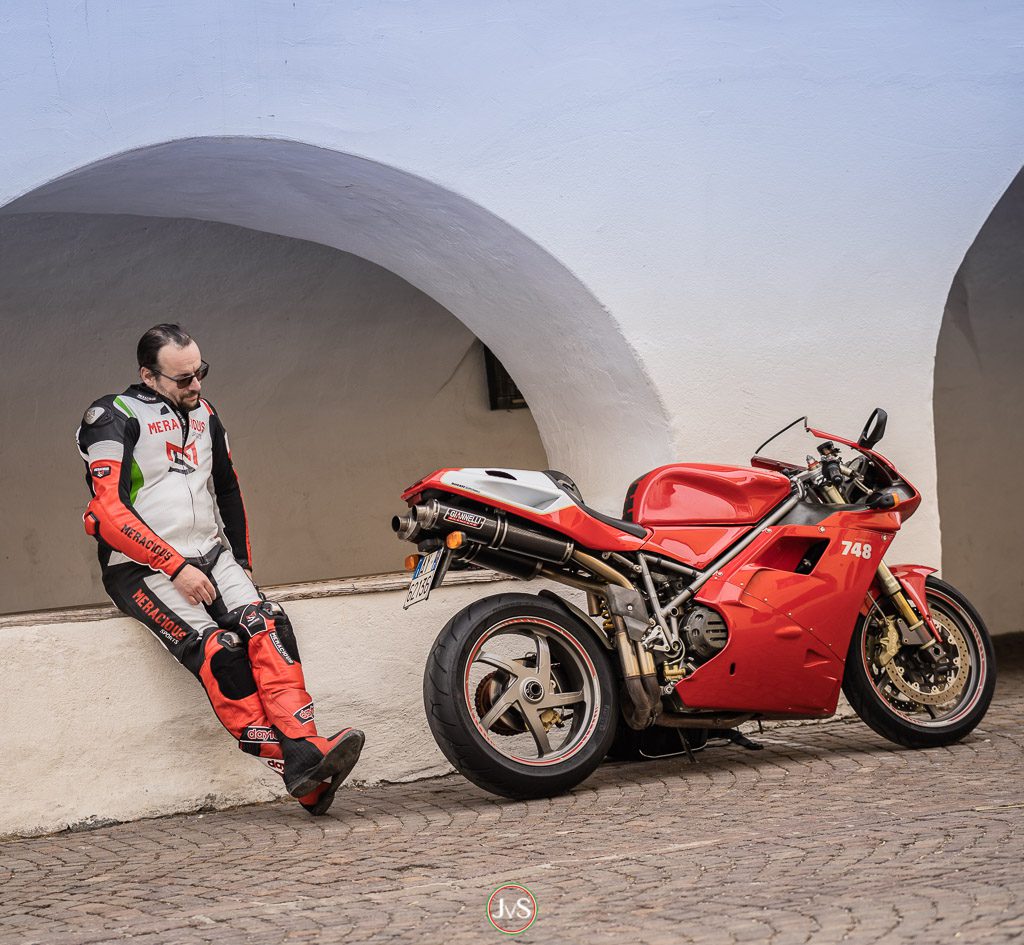
Soon we will reach the 100,000 km mark
But when she stands at the top of the Stelvio pass, between her MotoGP nieces with V4s and 200 hp, between the ground-to-ground rockets from Bavaria and Japan that will soon be able to drive themselves thanks to software updates, she still attracts all eyes.
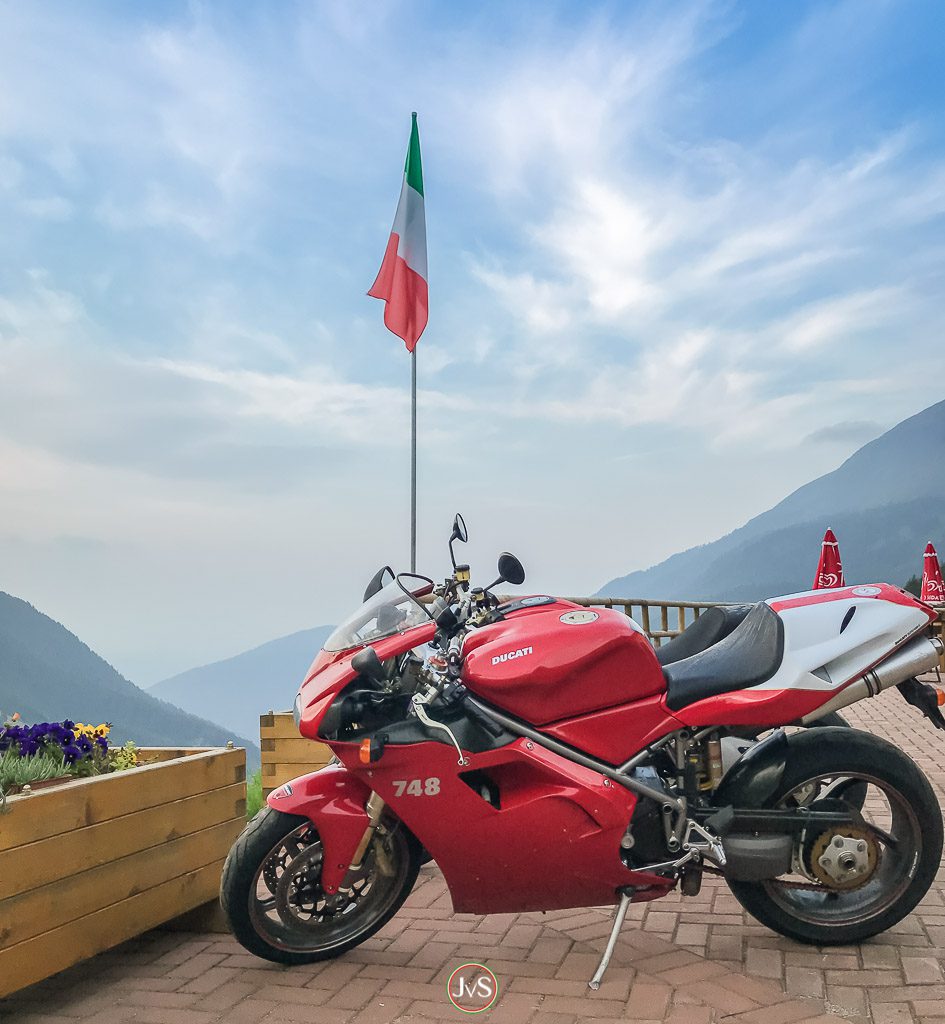
Italian hot-blooded: My Ducati 748s
Perfectly matching:

Ducati 748s – A motorcycle full of character

In the snow with my motorcycle